


Thien's paper got the cover image on Chemical Communications

Wiley Interview

The Wiley Network is an online community designed to offer advice, ideas, and collaboration opportunities for researchers, learners, and professionals as they pursue their goals. Read more and participate!
Interviewed by Hankook Ilbo

Interviewed at KAIST Podcast for Jeehye's work
 Mik Fanguy interviewed Cafer for Jeehye's paper on the water treatment by COP-99. The interview is now online at KAIST Podcast with additional coverage by Professor Mik Fanguy of the College of Liberal Arts and Convergence Science, and Scientific Communicator Dan Kopperud. You can listen to the podcast here or you can visit the KAIST Podcast page to view all. You should also subscribe the feed on your mobile phone!
C&EN coverage for Jeehye's paper

Cafer was profiled by Chemistry World
 |
| Click here to read the whole story by Jennifer Newton |
How did you get into chemistry?
My father is a teacher but he always wanted to be a professor. I think someone said you usually follow your parents’ dreams rather than their current jobs.I always knew I wanted to be a professor. My interest in chemistry goes back to my high school years. I represented Turkey twice at the International Chemistry Olympiad. Of course my interest in chemistry started before that. One of my mentors at high school got me interested in chemistry because he taught how it is related to life in general. He spoke of daily life items like soap, shampoo, fabric, dyes and drugs. He said everything is chemistry. So I thought – if everything is chemistry then I need to do chemistry. I saw I could make an immediate impact if I studied chemistry. I still keep that in mind – that I need to make an immediate impact on people’s lives.

Before the move I was in the US for about 10 years. I got my PhD in Texas at Rice University and was a postdoc at the University of California, Santa Barbara. My postdoc advisor, Galen Stucky, had a very distinguished position here at KAIST in Korea and he came here briefly to do some teaching and other things. Galen is no longer involved here but his previous involvement helped me to think this position was a possibility. I came here and I realised it’s a great environment with highly motivated people.
C&EN coverage for Prof. Yavuz
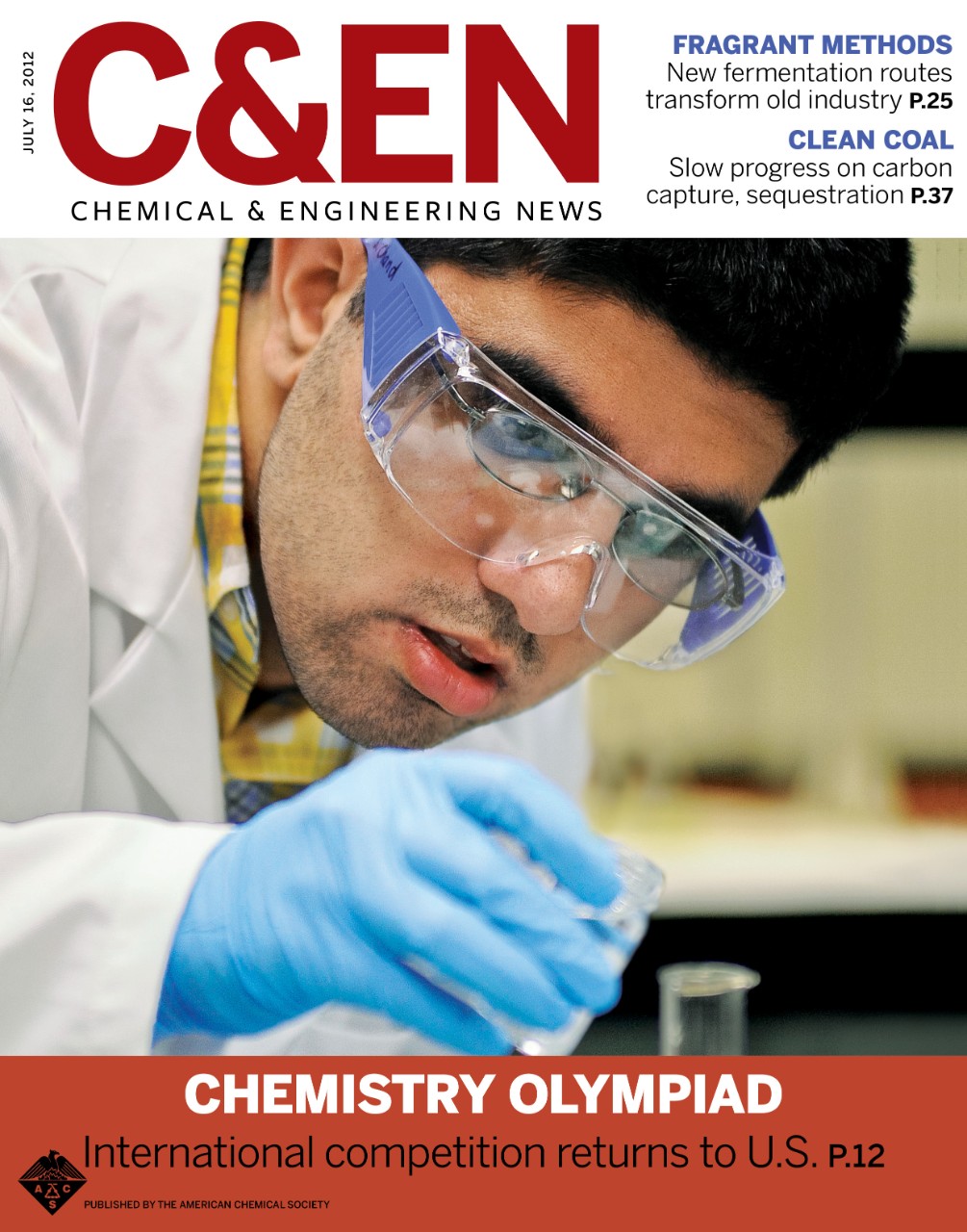 |
| click to read the whole story by Linda Wang |
"MEANWHILE, in South Korea, Turkish chemist Cafer T. Yavuz is designing new materials from oxide and organic building blocks to address environmental challenges.
Yavuz represented Turkey in 1997 in Montreal and in 1998 in Melbourne, Australia, winning a silver and bronze medal, respectively. He is now an assistant professor at the Korea Advanced Institute of Science Technology (KAIST).
ONE Lab at CNSI News
 International Group Meeting on Environmental Applications of Microbial-Nanomaterial Interactions between KAIST and UCLA
January 19, 2011 - The research groups of Shaily Mahendra, PhD, Assistant Professor, Civil and Environmental Engineering at UCLA and Cafer T. Yavuz, PhD, assistant professor, Graduate School of Energy, Environment, Water, and Sustainability of KAIST
Nano rust was on Science Channel
 Discovery's Science Channel had our nano rust project covered in their "Nano water" episode along with MIT's Francesco Stellacci's nano sponges that soak up spills. Click the following link to view the video:http://science.discovery.com/videos/brink-package-nano-water.html
Yenigun daily featured my comments on their frontpage
 On the Arsenic crisis in Izmir's (Turkey) drinking water system, I urged the public to be calm and not worry much. The issue will be resolved in 4 months and the toxicity of the current levels will not surmount to the fatal level although the carcinogenic effect of Arsenic is still at large. Scientists still not sure about how much arsenic in water can trigger tumor formations and for this very reason I would be cautious when drinking water with high levels of arsenic.
And CNN Turk interviewed over 7 pm prime time news about our "pollution magnet" study.
Times Higher Education interviewed for Elsevier spam email

Finding me from the blog post I wrote in May, Times Higher Education included my comments in their story about the recent Elsevier spam email. Click here to read the full story.
It starts like this:
Aktuel interviewed for the recent Arsenic contraversy in Turkey

The popular Turkish magazine, Aktuel interviewed me once again but this time for my comments on the recent Arsenic problem in Ankara, Turkey's capital city. Click here to reach to the article.
Recent coverage by Aktuel magazine
 One of the leading weekly magazines of Turkey, Yeni Aktuel, featured our study in its latest issue. Titled as "Dunyanin Arsenigini Bu Turk Temizleyecek!" (This Turk will clean all the Arsenic in the world), story (by Urun Dirier) highlighted Esquire magazine's recent honor.
The article starts like this:
Esquire Magazine selected our work in "Six Ideas That Will Change The World"
 The Esquire magazine selected our rust and edible oil method for making magnetite nanocrystals as one of the "Six Ideas That Will Change The World". Listed as the 3rd, it was dubbed "The Pollution Magnet". The article appeared in their "BEST & BRIGHTEST 2007" section.
The others ideas are:
Our work listed in Top Five Nanotech Breakthroughs of 2006 by Forbes

In a Forbes/Wolfe Nanotech Report (on 12.27.06, 8:30 AM ET), Josh Wolfe listed our work as one of the "Top Five Nanotech Breakthroughs Of 2006" under the title "Nanomagnets to clean up drinking water". Click here to view the article.
Subscribe to:
Posts (Atom)