Precious metal recovery from electronic waste by a porous porphyrin polymer

Y. Hong, D. Thirion, S. Subramanian, M. Yoo, H. Choi, H. Y. Kim, J. F. Stoddart*, C. T. Yavuz*
Proc. Natl. Acad. Sci., 117 (28), 16174-16180 (2020).
DOI: 10.1073/pnas.2000606117


Urban mining of precious metals from electronic waste, such as printed circuit boards (PCB), is not yet feasible because of the lengthy isolation process, health risks, and environmental impact. Although porous polymers are particularly effective toward the capture of metal contaminants, those with porphyrin linkers have not yet been considered for precious metal recovery, despite their potential. Here, we report a porous porphyrin polymer that captures precious metals quantitatively from PCB leachate even in the presence of 63 elements from the Periodic Table. The nanoporous polymer is synthesized in two steps from widely available monomers without the need for costly catalysts and can be scaled up without loss of activity. Through a reductive capture mechanism, gold is recovered with 10 times the theoretical limit, reaching a record 1.62 g/g. With 99% uptake taking place in the first 30 min, the metal adsorbed to the porous polymer can be desorbed rapidly and reused for repetitive batches. Density functional theory (DFT) calculations indicate that energetically favorable multinuclear-Au binding enhances adsorption as clusters, leading to rapid capture, while Pt capture remains predominantly at single porphyrin sites.


[Continue reading...]

Gold Recovery from E-Waste by Porous Porphyrin–Phenazine Network Polymers

T. S. Nguyen, Y. Hong, N. A. Dogan, C. T. Yavuz*
Chem. Mater., 32, 12, 5343–5349 (2020).
DOI: 10.1021/acs.chemmater.0c01734

Gold recovery from electronic waste could prevent excessive mining with toxic extractants and provide a sustainable path for recycling precious metals. Unfortunately, no viable recycling is practiced, except burning electronic circuit boards in underdeveloped countries, mainly because of the lack of chemical scavengers as adsorbents. Here, we report the synthesis of a family of porphyrin–phenazine-based polymers and their gold-capturing properties as well as application in gold recovery from actual e-waste. The polymers show high selectivity toward gold as well as other precious metals. The Au(III) adsorption isotherms were well-fitted to the Langmuir adsorption model and proportionality between porosity and uptake capacity was observed. Solution pH values and illumination conditions were shown to have influences on the performance of the adsorbents with the highest capacity of 1.354 g/g obtained in acidic pH and under continuous UV irradiation. Such a remarkable capacity of 7 times the theoretical estimate was achieved through photochemical adsorption–reduction mechanism supported by the observed suppressing effect of oxidant on gold-capturing ability. The adsorbents are robust and recyclable, a significant advantage over other emerging materials.
[Continue reading...]

Triazatruxene-Based Ordered Porous Polymer: High Capacity CO2, CH4, and H2 Capture, Heterogeneous Suzuki–Miyaura Catalytic Coupling, and Thermoelectric Properties

A. E. Sadak*, E. Karakuş*, Y. Chumakov, N. A. Dogan, C. T. Yavuz 
ACS Appl. Energy Mater., 3, 5, 4983–4994 (2020). 

A hypercrosslinked ultramicroporous and ordered organic polymer network was synthesized from a planar trimer indole building block called triazatruxene (TAT) through anhydrous FeCl3 catalyzed Friedel–Crafts alkylation using methylal as a crosslinker. The polymer network is stable in a variety of chemicals and thermally durable. The hypercrosslinked network TATHCP shows a high BET (Brunauer–Emmet–Teller) specific surface area of 997 m2 g–1 with CO2 uptake capacity of 12.55 wt % at 273 K, 1.1 bar. Gas selectivities of 38.4 for CO2/N2, 7.8 for CO2/CH4, 40.6 for CO2/O2, and 32.1 for CO2/CO were achieved through IAST calculation. The PXRD analysis has revealed that TATHCP has a fully eclipsed structure in full agreement with Pawley refinement. The ordered 2D layers provide anisotropy that could be used in catalysis and thermoelectric measurements. After loading with Pd(II), TATHCP-Pd showed high catalytic activity in Suzuki–Miyaura cross coupling reaction with a wide range of reagents and excellent reaction yields of 90–98% with good recyclability. The structure of TATHCP-Pd was found to have two independent molecules of Pd(OAc)2 in the asymmetric unit cell which are arranged between two TATHCP layers. Thermoelectric properties of TATHCP showed a high Seebeck coefficient and ZT, a first and promising example in HCPs with applications in all-organic thermal energy recovery devices.
[Continue reading...]

Catalytic non-redox carbon dioxide fixation in cyclic carbonates

S. Subramanian§, J. Oppenheim§, D. Kim§, T. S. Nguyen, W. M. H. Silo, B. Kim, W. A. Goddard III*, C. T. Yavuz* 
Chem, 5, 3232-3242 (2019). §: Equal contribution.
DOI: 10.1016/j.chempr.2019.10.009

If cycloaddition of CO2 to epoxides is to become a viable non-redox CO2 fixation path, it is crucial that researchers develop an active, stable, selective, metal-free, reusable, and cost-effective catalyst. To this end, we report here a new catalyst that is based on imidazolinium functionality and is synthesized from an unprecedented, one-pot reaction of the widely available monomers terephthalaldehyde and ammonium chloride. We show that this covalent organic polymer (COP)-222 exhibits quantitative conversion and selectivity for a range of substrates under ambient conditions and without the need for co-catalysts, metals, solvent, or pressure. COP-222 is recyclable and has been demonstrated to retain complete retention of activity for over 15 cycles. Moreover, it is scalable to at least a kilogram scale. We determined the reaction mechanism by using quantum mechanics (density functional theory), showing that it involves nucleophilic-attack-driven epoxide ring opening (ND-ERO). This contrasts with the commonly assumed mechanism involving the concerted addition of chemisorbed CO2.
[Continue reading...]

Gold recovery using porphyrin-based polymer from electronic wastes: Gold desorption and adsorbent regeneration

J. Son, Y. Hong, G. Han, T. S. Nguyen, C. T. Yavuz, J. Han*
Sci. Total Environ., 704, 135405 (2020).
DOI: 10.1016/j.scitotenv.2019.135405

Electronic wastes containing precious metals have great potential as a sustainable source of such metals. Separation and refining, however, remain complicated, and none of the existing technologies have yet experienced commercialization. A novel porphyrin-based porous polymer, named COP-180, was recently introduced as a powerful adsorbent option, especially for gold, and in this study, aspects of desorption and recovery of adsorbed gold and regeneration of the polymer were investigated. A hydrometallurgical method using non-cyanide leaching agents was developed, and an acid thiourea-based solution was found to be particularly suited for the method based on COP-180 with gold desorption efficiency of 97%. Fourier-transform infrared spectroscopy spectra demonstrated the unaffected structure of COP-180 after desorption, implying the potential of its reuse. This high desorption efficiency was achieved even without typical aiding agents by means of a formamidine disulfide-mediated route that prevented thiourea consumption, which is considered a major drawback of the otherwise promising reagent. Using this method, the polymer was able to maintain more than 94% desorption efficiency after five times of regeneration. The results suggest that acid thiourea can offer a workable means of recovering gold particularly from the excellent gold-adsorbent of COP-180, and that repeated regeneration is also possible.
[Continue reading...]

Zwitterion π-conjugated network polymer based on guanidinium and β-ketoenol as a heterogeneous organocatalyst for chemical fixation of CO2 into cyclic carbonates

M. Garai, V. Rozyyev, Z. Ullah, A. Jamal, C. T. Yavuz*
APL Mater., 7, 111102 (2019). Open Access
DOI: 10.1063/1.5122017

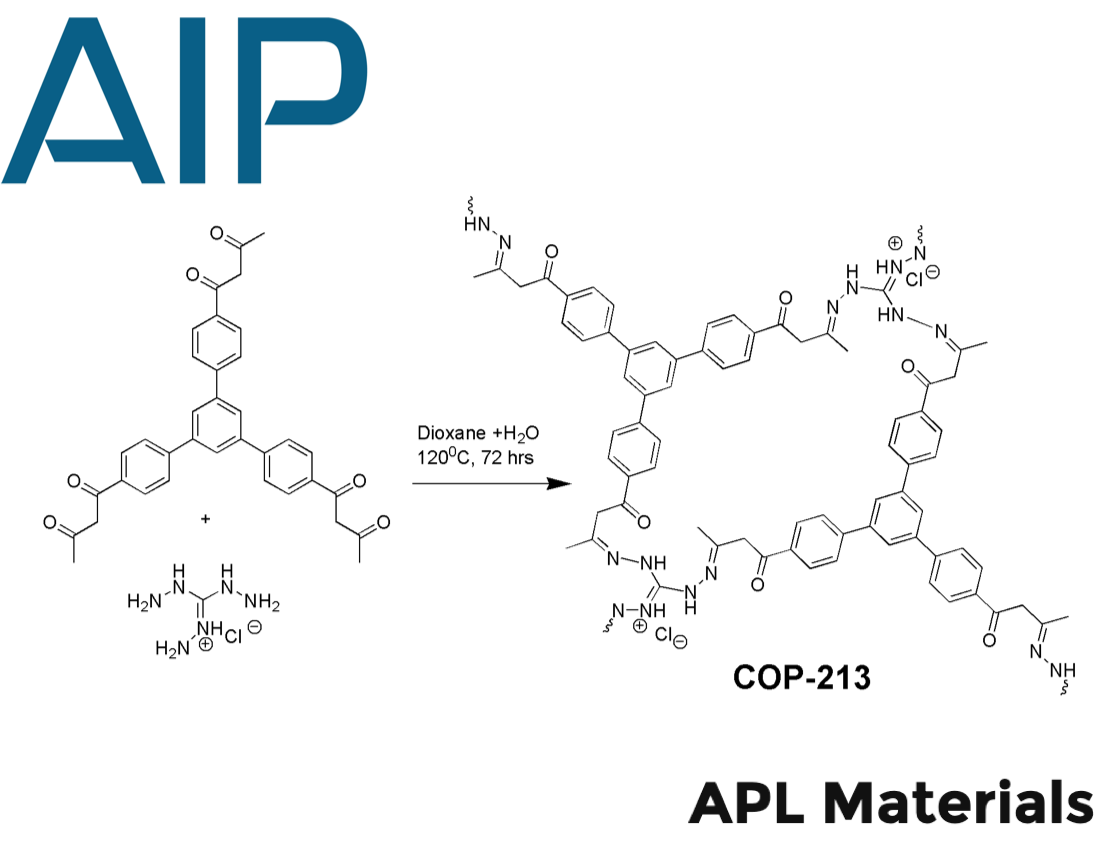
The chemical fixation of CO2 with epoxides to cyclic carbonate is an attractive 100% atom economic reaction. It is a safe and green alternative to the route from diols and toxic phosgene. In this manuscript, we present a new zwitterionic π–conjugated catalyst (Covalent Organic Polymer, COP-213) based on guanidinium and β-ketoenol functionality, which is synthesized from triaminoguanidinium halide and β-ketoenols via the ampoule method at 120 °C. The catalyst is characterized by FTIR-attenuated total reflection (ATR), Powder X-Ray diffraction, thermogravimetric analysis, XPS, and for surface area Brunauer–Emmett–Teller and CO2 uptake. It shows quantitative conversion and selectivity in chemical fixation of CO2 to epoxides under ambient conditions and without the need for cocatalysts, metals, solvent, or pressure. The catalyst can be recycled at least three times without the loss of reactivity. 
[Continue reading...]

Fluorinated covalent organic polymers for high performance sulfur cathodes in lithium–sulfur batteries

H. Shin§, D. Kim§, H. J. Kim§, J. Kim, K. Char*, C. T. Yavuz*, J. W. Choi*
Chem. Mater., accepted (2019). §: Equal contribution
DOI: 10.1021/acs.chemmater.9b01986

Lithium–sulfur (Li–S) batteries by far offer higher theoretical energy density than that of the commercial lithium-ion battery counterparts, but suffer predominantly from an irreversible shuttling process involving lithium polysulfides. Here, we report a fluorinated covalent organic polymer (F-COP) as a template for high performance sulfur cathodes in Li–S batteries. The fluorination allowed facile covalent attachment of sulfur to a porous polymer framework via nucleophilic aromatic substitution reaction (SNAr), leading to high sulfur content, e.g., over 70 wt %. The F-COP framework was microporous with 72% of pores within three well-defined pore sizes, viz. 0.58, 1.19, and 1.68 nm, which effectively suppressed polysulfide dissolution via steric and electrostatic hindrance. As a result of the structural features of the F-COP, the resulting sulfur electrode exhibited high electrochemical performance of 1287.7 mAh g–1 at 0.05C, 96.4% initial Columbic efficiency, 70.3% capacity retention after 1000 cycles at 0.5C, and robust operation for a sulfur loading of up to 4.1 mgsulfur cm–2. Our findings suggest the F-COP family with the adaptability of SNAr chemistry and well-defined microporous structures as useful frameworks for highly sustainable sulfur electrodes in Li–S batteries.
[Continue reading...]

High-capacity methane storage in flexible alkane-linked porous aromatic network polymers

V. Rozyyev, D. Thirion, R. Ullah, J. Lee, M. Jung, H. Oh, M. Atilhan*, C. T. Yavuz*
Nat. Energy, 4, 604-611, (2019).
DOI: 10.1038/s41560-019-0427-x
Readcube link to read for free

Adsorbed natural gas (ANG) technology is a viable alternative to conventional liquefied or compressed natural-gas storage. Many different porous materials have been considered for adsorptive, reversible methane storage, but fall short of the US Department of Energy targets (0.5 g g−1, 263 l l−1). Here we prepare a flexible porous polymer, made from benzene and 1,2-dichloroethane in kilogram batches, that has a high methane working capacity of 0.625 g g−1 and 294 l l−1 when cycled between 5 and 100 bar pressure. We suggest that the flexibility provides rapid desorption and thermal management, while the hydrophobicity and the nature of the covalently bonded framework allow the material to tolerate harsh conditions. The polymer also shows an adsorbate memory effect, where a less adsorptive gas (N2) follows the isotherm profile of a high-capacity adsorbate (CO2), which is attributed to the thermal expansion caused by the adsorption enthalpy. The high methane capacity and memory effect make flexible porous polymers promising candidates for ANG technology.
[Continue reading...]

Sustainable synthesis of superhydrophobic perfluorinated nanoporous networks for small molecule separation

S. Kim§, D. Thirion§, T. S. Nguyen, B. Kim, N. A. Dogan, C. T. Yavuz* 
Chem. Mater., 31, 14, 5206-5213, (2019). §: Equal contribution
DOI: 10.1021/acs.chemmater.9b01447

Nanoporous polymers offer great promise in chemical capture and separations because of their versatility, scalability, and robust nature. Here, we report a general methodology for one-pot, metal-free, and room-temperature synthesis of nanoporous polymers by highly stable carbon–carbon bond formation. Three new polymers, namely, COP-177, COP-178, and COP-179, are derived from widely available perfluoroarenes and found to be superhydrophobic, microporous, and highly stable against heat, acid, base, and organic solvents. Nitrile, amine, and ether functionalities were successfully installed by SNAr-type postfunctionalization and were shown to increase CO2 uptake twice and CO2/N2 selectivity 4-fold. Due to its inherent superhydrophobicity, COP-177 showed high organic solvent uptake both in liquid and vapor form. Furthermore, in a first of its kind, by combining microporosity and hydrophobicity, COP-177 separated two small molecules with the same boiling point in a continuous column setting.
[Continue reading...]

Sustainable porous polymer catalyst for size-selective cross-coupling reactions

S. Kim, B. Kim, N. A. Dogan, C. T. Yavuz*
ACS Sustain. Chem. Eng., 7, 10865-10872 (2019).
DOI: 10.1021/acssuschemeng.9b01729

A new, high surface area, nanoporous polymer (COP-220) was synthesized using sustainable building blocks, namely, a food coloring dye (erythrosine B) and a commercial alkyne. During the Sonogashira coupling, it is observed that Pd and Cu ions and triphenylphosphine ligands of the catalyst get trapped inside the pores. The remnant synthesis catalyst components were characterized in detail and were tested as a new catalyst for Suzuki–Miyaura coupling reactions. COP-220 showed conversion yields comparable to the commercial homogeneous catalyst Pd(PPh3)2Cl2 with an additional advantage of size-dependent catalytic activity when bulkier substrates were used. COP-220 was highly stable under thermal and chemical treatments and recyclable with no loss of activity. These findings show a clear need for extensive characterization of nanoporous polymers made through cross-coupling reactions and the potential of the trapped catalysts for new catalytic activity without additional loading.
[Continue reading...]

Nanoporous Polymer Microspheres with Nitrile and Amidoxime Functionalities for Gas Capture and Precious Metal Recovery from E-Waste

N. A. Dogan, Y. Hong, E. Ozdemir, C. T. Yavuz*
ACS Sustain. Chem. Eng., 7 (1), 123–128 (2019).
Invited paper for the special issue on advanced porous materials
DOI: 10.1021/acssuschemeng.8b05490 

Nanoporous materials could offer sustainable solutions to gas capture and precious metal recovery from electronic waste. Despite this potential, few reports combine target functionalities with physical properties such as morphology control. Here, we report a nanoporous polymer with microspherical morphology that could selectively capture gold from a mixture of 15 common transition metals. When its nitriles are converted into amidoxime, the capacity increases more than 20-fold. Amidoximes are also very effective in CO2 binding and show a record high CO2/CH4 selectivity of 24 for potential use in natural gas sweetening. The polymer is successfully synthesized in 1 kg batches starting from sustainable inexpensive building blocks without the need for costly catalysts. Because the morphology is controlled from the beginning, the nanoporous materials studied in lab scale could easily be moved into respective industries.

Link to the journal webpage
[Continue reading...]

Structural Elucidation of Covalent Organic Polymers (COP) and Their Linker Effect on Gas Adsorption Performance via Density Functional Theory Approach

S. Aparicio*, C. T. Yavuz, M. Atilhan*
ChemistrySelect, 3, 8294– 8305 (2018).
DOI: 10.1002/slct.201801849

Investigation of the binding affinity gases on porous adsorbents are important for establishing understanding of effective carbon dioxide adsorption and design target specific sorbents for capturing hazardous gases for environmental protection and fuel upgrading. A Density Functional Theory (DFT) study that highlights the impact of covalent organic polymer (COP) design has been conducted to explain the molecular and electronic structure, investigate the interaction sites and elucidate the experimental findings on carbon dioxide (CO2) and nitrogen (N2) sorption on these porous structures. DFT calculations were used to infer the details of the type and the strength of the polymer – gas interaction modes at various interaction sites as well as to quantify short‐range interactions between the polymer – gas via topological characteristics analysis of intermolecular forces. Results obtained in this study were used to shed light on CO2 and N2 affinity of the studied polymer structures; interpretations regarding to the macroscopic behaviors were discussed and conclusions were attained on the characteristics of the adsorption type and mechanism.
[Continue reading...]

Applicability of disulfide-polymer particles surface embedded on alginate beads for cadmium removal from airport derived stormwater

D. Ko, H. Kim, H. Lee, C. T. Yavuz, H. R. Andersen, Y. Hwang*
J. Environ. Chem. Eng., 6, 4124–4129 (2018).
DOI: 10.1016/j.jece.2018.06.007

Stormwater runoff derived from airports causes severe cadmium contamination in excess of the maximum limit level and is difficult to treat due to the irregular contamination levels from scattered rainfall. To overcome this and remove cadmium from runoff, a new reactive filtration column is introduced. Sulfur functionalized polymer particles were successfully embedded onto the surface of alginate bead (DiS-algi) and simulated a real stormwater treatment filtration column. The DiS-algi shows 22.3 mg/g of batch and 877 μg/g of continuous flow sorption capacity. Also, the results for the new sorption material show that within 6 mins half of the cadmium was removed with 31 L/mg of Langmuir sorption affinity, outperforming an activated carbon filter. From a breakthrough test the reactive column shows complete uptake of cadmium from a contaminated flow, lasting two hours until reaching the breakthrough point. Furthermore, regeneration tests of the column verified its reusability. DiS-algi appears to be a viable new cadmium sorption material for airport derived stormwater runoff filtration systems.
[Continue reading...]

Disulfide polymer grafted porous carbon composites for heavy metal removal from stormwater runoff

D. Ko*, P. D. Mines, M. H. Jakobsen, C. T. Yavuz, H. C. B. Hansen, H. R. Andersen
Chem. Eng. J., 348, 685–692 (2018).
DOI: 10.1016/j.cej.2018.04.192

The emerging concern of heavy metal pollution derived from stormwater runoff has triggered a demand for effective heavy metal sorbents. To be an effective sorbent, high affinity along with rapid sorption kinetics for environmental relevant concentrations of heavy metals is important. Herein, we have introduced a new composite suitable for trace metal concentration removal, which consists of cheap and common granular activated carbon covered with polymers containing soft bases, thiols, through acyl chlorination (DiS-AC). Material characterization demonstrated that the polymer was successfully grafted and grown onto the surface of the carbon substrate. The distribution coefficient for Cd2+ bonding was 89·103 L/kg at a solution concentration of 0.35 mg/L, which is notably higher than sorption affinities for Cd2+ seen in conventional sorbents. The sorption isotherm is well described by the Freundlich isotherm and within an hour, half of the initial trace (0.2 mg/L) concentration of Cd2+ was removed by the DiS-AC at a sorbent loading of 2 g/L. Therefore, the novel material DiS-AC promises to be an ideal candidate for filters treating stormwater runoff.
[Continue reading...]

Molecular Insights into Benzimidazole-linked Polymer Interactions with Carbon Dioxide and Nitrogen

S. Aparicio*, C. T. Yavuz, M. Atilhan*
ChemistrySelect, 3, 3691 – 3701 (2018).
DOI: 10.1002/slct.201800253

Investigation of the binding affinity gases on porous adsorbents are important for establishing understanding of effective carbon dioxide adsorption and design target specific sorbents for capturing hazardous gases for environmental protection and fuel upgrading. A density functional theory (DFT) study that highlights the impact of benzimidazole‐linked polymer structure design has been conducted to explain the molecular and electronic structure, investigate the interaction sites and elucidate the experimental results on carbon dioxide and nitrogen sorption on these porous structures. DFT calculations were used to infer the strength of the polymer – gas interaction modes as well as to quantify short‐range interactions between the polymer – gas via topological characteristics analysis of intermolecular forces. Obtained results shed light on the carbon dioxide and nitrogen affinity as well as the selectivity during the adsorption process, and yet conclusions were attained on the characteristics of the adsorption type and mechanism in this study.
[Continue reading...]

Granular activated carbon with grafted nanoporous polymer enhances nanoscale zero-valent iron impregnation and water contaminant removal

P. D. Mines, B. Uthuppu, D. Thirion, M. H. Jakobsen, C. T. Yavuz, H. R. Andersen, Y. Hwang*
Chem. Eng. J., 339, 22-31 (2018).
DOI: 10.1016/j.cej.2018.01.102

Granular activated carbon was customized with a chemical grafting procedure of a nanoporous polymeric network for the purpose of nanoscale zero-valent iron impregnation and subsequent water contaminant remediation. Characterization of the prepared composite material revealed that not only was the polymer attachment and iron impregnation successful, but also that the polymeric shell acted as a protective barrier against the effects of oxidation from the surrounding environment, nearly 99% of total iron content was in the form of zero-valent iron. When applied towards the remediation of two common water contaminants, nitrobenzene and nitrate, the composite material exploited the qualities of both the activated carbon and the polymeric network to work together in a synergistic manner. In that the increased protection from oxidation allowed for increased reactivity of the nanoscale zero-valent iron, and that the adsorption abilities of both the carbon and the polymer achieved a higher amount of total removal of the contaminants.
[Continue reading...]

Sustainable nanoporous benzoxazole networks as metal-free catalysts for one-pot oxidative self-coupling of amines by air oxygen

S. Subramanian, H. A. Patel, Y. Song, C. T. Yavuz*
Adv. Sustain. Syst., 1, 1700089, (2017).
DOI: 10.1002/adsu.201700089

The development of sustainable organocatalysts with porosity, high stability, and excellent catalytic activity offers a clean and green alternative to precious metal catalysts. Here, an efficient, nanoporous, heterogeneous benzoxazole catalyst is reported for aerobic oxidative coupling of amines. A molecular design strategy is presented to functionalize primary amines to produce valuable products under one-pot, open-air reaction conditions. Unprecedented and previously unknown, the stable imine intermediate catalyzes its own formation, also known as autocatalysis, enabling a direct and favorable access to amino acids, even if the catalysts are absent. The biomimetic benzoxazole catalysts developed here provide quantitative catalytic activity over 50 cycles with favorable kinetics with no degradation. This work also marks the first use of benzoxazoles for oxidative catalytic reactions.
[Continue reading...]

Reversible water capture by a charged metal-free porous polymer

J. Byun, H. A. Patel, D. ThirionC. T. Yavuz*
Polymer, 126, 308-313, (2017).
Invited paper for the special issue on Porous Polymers
DOI: 10.1016/j.polymer.2017.05.071

Climate change and industrial pollution threatens the availability of clean water. Although established protocols of water treatment exist, water capture by porous materials has emerged as a viable alternative to energy intensive processes. Here we introduce a new charged porous polymer that is capable of capturing and releasing water by simple humidity or temperature swings. The quaternary amines on the framework structure attract water molecules and further solvate by coordination. The porosity of the network structure also provides enough void where water can diffuse throughout the solid. Water uptake capacity of the porous polymer surpasses common desiccants like silica gel and molecular sieves, and has the potential to act as an organic desiccant in applications like electronics or food packaging.
[Continue reading...]

Selective removal of cationic micro-pollutants using disulfide-linked network structures

M. S. Atas, S. Dursun, H. Akyildiz, M. Citir, C. T. Yavuz*, M. S. Yavuz*
RSC Adv., 7, 25969-25977, (2017). Open Access
DOI: 10.1039/C7RA04775D

Micropollutants are found in all water sources, even after thorough treatments that include membrane filtration. New ones emerge as complex molecules are continuously produced and discarded after used. Treatment methods and sorbent designs are mainly based on non-specific interactions and, therefore, have been elusive. Here, we developed swellable covalent organic polymers (COP) with great affinity towards micropollutants, such as textile industry dyes. Surprisingly, only cationic dyes in aqueous solution were selectively and completely removed. Studies of the COPs surfaces led to a gating capture, where negatively charged layer attracts cationic dyes and moves them inside the swollen gel through diffusive and hydrophobic interaction of the hydrocarbon fragments. Despite its larger molecular size, crystal violet has been taken the most, 13.4 mg g−1, surpassing all competing sorbents. The maximum adsorption capacity increased from 12.4 to 14.6 mg and from 8.9 to 11.4 mg when the temperature of dye solution was increased from 20 to 70 °C. The results indicated that disulfide-linked COPs are attractive candidates for selectively eliminating cationic dyes from industrial wastewater due to exceptional swelling behaviour, low-cost and easy synthesis.
[Continue reading...]

Direct access to primary amines and particle morphology control in nanoporous CO2 sorbents

N. A. Dogan§, E. Ozdemir§, C. T. Yavuz*
ChemSusChem10, 2130-2134, (2017). DOI: 10.1002/cssc.201700190. §: Equal contribution


Chemical tuning of nanoporous, solid sorbents for an ideal CO2 binding requires unhindered amine functional groups on the pore walls. Although common for soluble organics, post-synthetic reduction of nitriles in porous networks often fail due to the insufficient and irreversible metal hydride penetration. Here, we synthesized a nanoporous network with pendant nitrile groups, microsphere morphology and in large scale. The hollow microspheres were easily decorated with primary amines through in situ reduction by widely available boranes. CO2 capture capacity of the modified sorbent was increased up to an eight times of the starting nanoporous network with a high heat of adsorption (98 kJ/mol). Surface area can be easily tuned between 1 and 354 m2/g. Average particle size (~50 µm) is also quite suitable for CO2 capture applications where processes like fluidized bed require spheres of micron sizes.
[Continue reading...]
 
Copyright © . ONE Lab - Prof. Cafer T. Yavuz - Posts · Comments
Theme Template by BTDesigner · Powered by Blogger