Precious metal recovery from electronic waste by a porous porphyrin polymer

Y. Hong, D. Thirion, S. Subramanian, M. Yoo, H. Choi, H. Y. Kim, J. F. Stoddart*, C. T. Yavuz*
Proc. Natl. Acad. Sci., 117 (28), 16174-16180 (2020).
DOI: 10.1073/pnas.2000606117


Urban mining of precious metals from electronic waste, such as printed circuit boards (PCB), is not yet feasible because of the lengthy isolation process, health risks, and environmental impact. Although porous polymers are particularly effective toward the capture of metal contaminants, those with porphyrin linkers have not yet been considered for precious metal recovery, despite their potential. Here, we report a porous porphyrin polymer that captures precious metals quantitatively from PCB leachate even in the presence of 63 elements from the Periodic Table. The nanoporous polymer is synthesized in two steps from widely available monomers without the need for costly catalysts and can be scaled up without loss of activity. Through a reductive capture mechanism, gold is recovered with 10 times the theoretical limit, reaching a record 1.62 g/g. With 99% uptake taking place in the first 30 min, the metal adsorbed to the porous polymer can be desorbed rapidly and reused for repetitive batches. Density functional theory (DFT) calculations indicate that energetically favorable multinuclear-Au binding enhances adsorption as clusters, leading to rapid capture, while Pt capture remains predominantly at single porphyrin sites.


[Continue reading...]

Gold Recovery from E-Waste by Porous Porphyrin–Phenazine Network Polymers

T. S. Nguyen, Y. Hong, N. A. Dogan, C. T. Yavuz*
Chem. Mater., 32, 12, 5343–5349 (2020).
DOI: 10.1021/acs.chemmater.0c01734

Gold recovery from electronic waste could prevent excessive mining with toxic extractants and provide a sustainable path for recycling precious metals. Unfortunately, no viable recycling is practiced, except burning electronic circuit boards in underdeveloped countries, mainly because of the lack of chemical scavengers as adsorbents. Here, we report the synthesis of a family of porphyrin–phenazine-based polymers and their gold-capturing properties as well as application in gold recovery from actual e-waste. The polymers show high selectivity toward gold as well as other precious metals. The Au(III) adsorption isotherms were well-fitted to the Langmuir adsorption model and proportionality between porosity and uptake capacity was observed. Solution pH values and illumination conditions were shown to have influences on the performance of the adsorbents with the highest capacity of 1.354 g/g obtained in acidic pH and under continuous UV irradiation. Such a remarkable capacity of 7 times the theoretical estimate was achieved through photochemical adsorption–reduction mechanism supported by the observed suppressing effect of oxidant on gold-capturing ability. The adsorbents are robust and recyclable, a significant advantage over other emerging materials.
[Continue reading...]

Direct Z-Scheme Tannin–TiO2 Heterostructure for Photocatalytic Gold Ion Recovery from Electronic Waste

K. R. Kim, S. Choi, C. T. Yavuz, Y. S. Nam*
ACS Sustain. Chem. Eng., 8, 19, 7359–7370 (2020).
DOI: 10.1021/acsaem.0c00539

Precious-metal recovery from industrial wastewater has received considerable attention because of rapidly increasing amounts of electronic waste. Existing technologies have yet to be widely applied due to their high cost and low selectivity toward precious-metal ions. Herein, we report a direct Z-scheme tannin–TiO2 heterostructure for selective gold adsorption from electronic waste under solar irradiation. The tannin-coated TiO2 nanoparticles were prepared by a simple dipping method, and under light illumination, both tannin and TiO2 can serve as photosensitive components for the reduction of metal ions, with metal-to-ligand charge transfer from TiO2 to tannin extending the lifetime of the excited electrons. Moreover, no additional electron donors are required because the tannin layer scavenges the reactive oxygen species generated by the holes from the light-activated TiO2 surface. The heterostructure allows for the highly efficient photocatalytic recovery of gold ions, with 11 times higher adsorption capacity in the light compared to the dark. High selectivity toward gold ions was also demonstrated using a metal ion mixture including nine different metal ions that are commonly found in electronic waste. Our findings suggest that the Z-scheme heterostructure of polyphenol and semiconductor provides a promising photochemical pathway for efficient and selective metal ion recovery from electronic waste.
[Continue reading...]

Triazatruxene-Based Ordered Porous Polymer: High Capacity CO2, CH4, and H2 Capture, Heterogeneous Suzuki–Miyaura Catalytic Coupling, and Thermoelectric Properties

A. E. Sadak*, E. Karakuş*, Y. Chumakov, N. A. Dogan, C. T. Yavuz 
ACS Appl. Energy Mater., 3, 5, 4983–4994 (2020). 

A hypercrosslinked ultramicroporous and ordered organic polymer network was synthesized from a planar trimer indole building block called triazatruxene (TAT) through anhydrous FeCl3 catalyzed Friedel–Crafts alkylation using methylal as a crosslinker. The polymer network is stable in a variety of chemicals and thermally durable. The hypercrosslinked network TATHCP shows a high BET (Brunauer–Emmet–Teller) specific surface area of 997 m2 g–1 with CO2 uptake capacity of 12.55 wt % at 273 K, 1.1 bar. Gas selectivities of 38.4 for CO2/N2, 7.8 for CO2/CH4, 40.6 for CO2/O2, and 32.1 for CO2/CO were achieved through IAST calculation. The PXRD analysis has revealed that TATHCP has a fully eclipsed structure in full agreement with Pawley refinement. The ordered 2D layers provide anisotropy that could be used in catalysis and thermoelectric measurements. After loading with Pd(II), TATHCP-Pd showed high catalytic activity in Suzuki–Miyaura cross coupling reaction with a wide range of reagents and excellent reaction yields of 90–98% with good recyclability. The structure of TATHCP-Pd was found to have two independent molecules of Pd(OAc)2 in the asymmetric unit cell which are arranged between two TATHCP layers. Thermoelectric properties of TATHCP showed a high Seebeck coefficient and ZT, a first and promising example in HCPs with applications in all-organic thermal energy recovery devices.
[Continue reading...]

Quantifying nitrogen effect on CO2 capture using isoporous network polymers

T. S. Nguyen, C. T. Yavuz*
Chem. Commun., 56, 4273-4275 (2020).
DOI: 10.1039/D0CC00982B
Cover Image DOI: 10.1039/D0CC90168G


The impact of nitrogen atoms on CO2 binding was evaluated for two isostructural porous bisimidazole-linked polymers (BILPs), which serendipitously had identical surface areas and pore size distributions, a very rare observation. The two structures differ only in the core of the trialdehyde component, the nitrogen atom (BILP-19) versus benzene ring (BILP-5). Such a slight difference, however, has brought about a stronger CO2 capture capacity of BILP-19 and hence increased CO2/N2 separation capability.
[Continue reading...]

Dry reforming of methane by stable Ni–Mo nanocatalysts on single-crystalline MgO

Y. Song, E. Ozdemir, S. Ramesh, A. Adishev, S. Subramanian, A. Harale, M. Albuali, B. A. Fadhel, A. Jamal, D. Moon, S. H. Choi, C. T. Yavuz*
Science, 367, 6479, 777-781 (2020).
DOI: 10.1126/science.aav2412

Large-scale carbon fixation requires high-volume chemicals production from carbon dioxide. Dry reforming of methane could provide an economically feasible route if coke- and sintering-resistant catalysts were developed. Here, we report a molybdenum-doped nickel nanocatalyst that is stabilized at the edges of a single-crystalline magnesium oxide (MgO) support and show quantitative production of synthesis gas from dry reforming of methane. The catalyst runs more than 850 hours of continuous operation under 60 liters per unit mass of catalyst per hour reactive gas flow with no detectable coking. Synchrotron studies also show no sintering and reveal that during activation, 2.9 nanometers as synthesized crystallites move to combine into stable 17-nanometer grains at the edges of MgO crystals above the Tammann temperature. Our findings enable an industrially and economically viable path for carbon reclamation, and the “Nanocatalysts On Single Crystal Edges” technique could lead to stable catalyst designs for many challenging reactions.

Perspective: Liyu Chen, Qiang Xu*, "Fewer defects, better catalysis?", p. 737
Research summary by Phil Szuromi, "Overcoming surface defects", p. 752-753
Highlighted in Chemistry World, C&ENNature Asia
Korean press release, English press release

Media Coverage:
Science Daily
Nanowerk
UPI
Phys.org
The Engineer
Wikipedia: 2020 in Science

Korean Media:
서울경제
해럴드경제
충청일보
교수신문
충남일보
베리타스알파
글로벌이코노믹
이뉴스투데이
뉴스핌
뉴스1
전자신문
국제뉴스
아시아경제
헬로디디
인더스트리뉴스
대전시티저널
에너지경제
아시아뉴스통신
[Continue reading...]

Catalytic non-redox carbon dioxide fixation in cyclic carbonates

S. Subramanian§, J. Oppenheim§, D. Kim§, T. S. Nguyen, W. M. H. Silo, B. Kim, W. A. Goddard III*, C. T. Yavuz* 
Chem, 5, 3232-3242 (2019). §: Equal contribution.
DOI: 10.1016/j.chempr.2019.10.009

If cycloaddition of CO2 to epoxides is to become a viable non-redox CO2 fixation path, it is crucial that researchers develop an active, stable, selective, metal-free, reusable, and cost-effective catalyst. To this end, we report here a new catalyst that is based on imidazolinium functionality and is synthesized from an unprecedented, one-pot reaction of the widely available monomers terephthalaldehyde and ammonium chloride. We show that this covalent organic polymer (COP)-222 exhibits quantitative conversion and selectivity for a range of substrates under ambient conditions and without the need for co-catalysts, metals, solvent, or pressure. COP-222 is recyclable and has been demonstrated to retain complete retention of activity for over 15 cycles. Moreover, it is scalable to at least a kilogram scale. We determined the reaction mechanism by using quantum mechanics (density functional theory), showing that it involves nucleophilic-attack-driven epoxide ring opening (ND-ERO). This contrasts with the commonly assumed mechanism involving the concerted addition of chemisorbed CO2.
[Continue reading...]

Gold recovery using porphyrin-based polymer from electronic wastes: Gold desorption and adsorbent regeneration

J. Son, Y. Hong, G. Han, T. S. Nguyen, C. T. Yavuz, J. Han*
Sci. Total Environ., 704, 135405 (2020).
DOI: 10.1016/j.scitotenv.2019.135405

Electronic wastes containing precious metals have great potential as a sustainable source of such metals. Separation and refining, however, remain complicated, and none of the existing technologies have yet experienced commercialization. A novel porphyrin-based porous polymer, named COP-180, was recently introduced as a powerful adsorbent option, especially for gold, and in this study, aspects of desorption and recovery of adsorbed gold and regeneration of the polymer were investigated. A hydrometallurgical method using non-cyanide leaching agents was developed, and an acid thiourea-based solution was found to be particularly suited for the method based on COP-180 with gold desorption efficiency of 97%. Fourier-transform infrared spectroscopy spectra demonstrated the unaffected structure of COP-180 after desorption, implying the potential of its reuse. This high desorption efficiency was achieved even without typical aiding agents by means of a formamidine disulfide-mediated route that prevented thiourea consumption, which is considered a major drawback of the otherwise promising reagent. Using this method, the polymer was able to maintain more than 94% desorption efficiency after five times of regeneration. The results suggest that acid thiourea can offer a workable means of recovering gold particularly from the excellent gold-adsorbent of COP-180, and that repeated regeneration is also possible.
[Continue reading...]

Zwitterion π-conjugated network polymer based on guanidinium and β-ketoenol as a heterogeneous organocatalyst for chemical fixation of CO2 into cyclic carbonates

M. Garai, V. Rozyyev, Z. Ullah, A. Jamal, C. T. Yavuz*
APL Mater., 7, 111102 (2019). Open Access
DOI: 10.1063/1.5122017

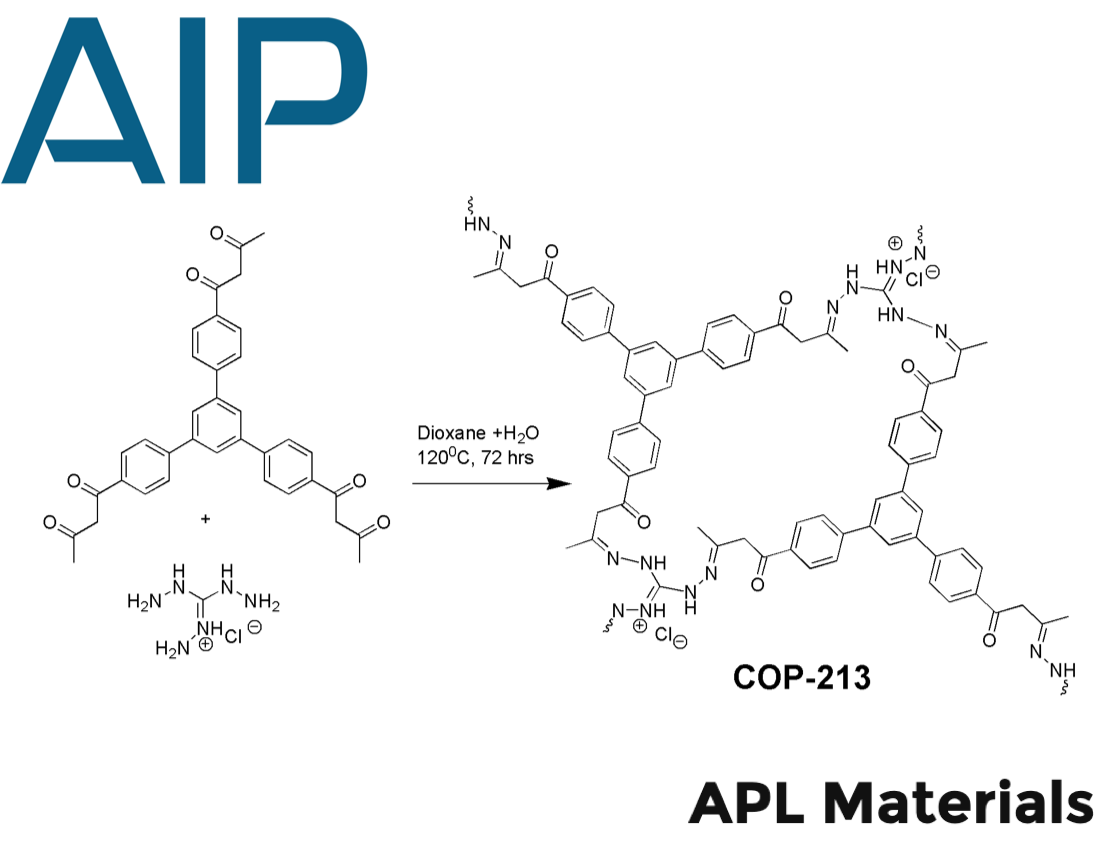
The chemical fixation of CO2 with epoxides to cyclic carbonate is an attractive 100% atom economic reaction. It is a safe and green alternative to the route from diols and toxic phosgene. In this manuscript, we present a new zwitterionic π–conjugated catalyst (Covalent Organic Polymer, COP-213) based on guanidinium and β-ketoenol functionality, which is synthesized from triaminoguanidinium halide and β-ketoenols via the ampoule method at 120 °C. The catalyst is characterized by FTIR-attenuated total reflection (ATR), Powder X-Ray diffraction, thermogravimetric analysis, XPS, and for surface area Brunauer–Emmett–Teller and CO2 uptake. It shows quantitative conversion and selectivity in chemical fixation of CO2 to epoxides under ambient conditions and without the need for cocatalysts, metals, solvent, or pressure. The catalyst can be recycled at least three times without the loss of reactivity. 
[Continue reading...]

Inversion of dispersion: Colloidal stability of calixarene modified metal-organic framework nanoparticles in non-polar media

U. Jeong, N. A. Dogan, M. Garai, T. S. Nguyen, J. F. Stoddart, C. T. Yavuz* 
J. Am. Chem. Soc., accepted, (2019).
DOI: 10.1021/jacs.9b04198

Making metal-organic frameworks (MOFs) which are stabilized in non-polar media is not as straightforward as their inorganic nanoparticle counterparts, since surfactants penetrate through the porous structures or dissolve the secondary building units (SBUs) through ligand-exchange linker modulator mechanisms. Herein we report that calixarenes stabilize UIO-66 nanoparticles effectively by remaining outside the grains through size exclusion, without pores becoming blocked, all the while providing amphiphilicity that permits the formation of stable colloidal dispersions with much narrower size distributions. Using the UIO-66 dispersed solutions, we showed that smooth films from an otherwise immiscible polystyrene can be made feasibly.
[Continue reading...]

A combined experimental and theoretical study on gas adsorption performance of amine and amide porous polymers

R. Ullah, H. A. Patel, S. Aparicio, C. T. Yavuz*, M. Atilhan*
Micropor. Mesopor. Mater., 279, 61-72 (2019).
DOI: 10.1016/j.micromeso.2018.12.011

In this manuscript, we report synthesis, characterization and application of amine and amide type covalent organic frameworks as CO2 adsorbent materials at various isotherms and wide pressure conditions. Furthermore, we also report a detailed density functional theory investigation of the studied adsorbents in order to explain their adsorption behaviors and provide comparisons with experimental results. The objective of this work was to investigate custom design porous polymers by building amine and amide functionalities in the final structures, whether they have efficient CO2 capturing performances at wide process conditions that covers both low and high pressure end applications to cover either pre- or post-combustion processes. On the other hand, energy storage performances of these materials were tested by performing H2 sorption experiments as well. Two porous polymers, namely COP-9 and COP-10, were characterized with BET, TGA and FTIR to evaluate the physical properties of studied porous polymers and then were tested for CO2, N2 and H2 adsorption both at low and high pressures. Studied materials were found to have compelling adsorption capacity mostly at high pressures and have very good selectivity for CO2/N2 and CO2/H2 respectively.
[Continue reading...]

Nanoporous Polymer Microspheres with Nitrile and Amidoxime Functionalities for Gas Capture and Precious Metal Recovery from E-Waste

N. A. Dogan, Y. Hong, E. Ozdemir, C. T. Yavuz*
ACS Sustain. Chem. Eng., 7 (1), 123–128 (2019).
Invited paper for the special issue on advanced porous materials
DOI: 10.1021/acssuschemeng.8b05490 

Nanoporous materials could offer sustainable solutions to gas capture and precious metal recovery from electronic waste. Despite this potential, few reports combine target functionalities with physical properties such as morphology control. Here, we report a nanoporous polymer with microspherical morphology that could selectively capture gold from a mixture of 15 common transition metals. When its nitriles are converted into amidoxime, the capacity increases more than 20-fold. Amidoximes are also very effective in CO2 binding and show a record high CO2/CH4 selectivity of 24 for potential use in natural gas sweetening. The polymer is successfully synthesized in 1 kg batches starting from sustainable inexpensive building blocks without the need for costly catalysts. Because the morphology is controlled from the beginning, the nanoporous materials studied in lab scale could easily be moved into respective industries.

Link to the journal webpage
[Continue reading...]

Highly efficient catalytic cyclic carbonate formation by pyridyl salicylimines

S. Subramanian, J. Park, J. Byun, Y. Jung, C. T. Yavuz*
ACS Appl. Mater. Interfaces, accepted.
DOI: 10.1021/acsami.8b00485

Cyclic carbonates as industrial commodities offer a viable non-redox carbon dioxide fixation, and suitable heterogeneous catalysts are vital for their widespread implementation. Here we report a highly efficient heterogeneous catalyst for CO2 addition to epoxides based on a newly identified active catalytic pocket consisting of pyridine, imine and phenol moieties. The polymeric, metal-free catalyst derived from this active site converts less reactive styrene oxide under atmospheric pressure in quantitative yield and selectivity to the corresponding carbonate. The catalyst doesn’t need additives, solvents, metals or co-catalysts, can be reused at least 10 cycles without loss of activity, and scaled up easily to a kg scale. DFT calculations reveal that the nucleophilicity of pyridine base gets stronger due to the conjugated imines and H-bonding from phenol accelerates the reaction forward by stabilizing the intermediate.

Link to the journal page
[Continue reading...]

Charge-specific size-dependent separation of water-soluble organic molecules by fluorinated nanoporous networks

J. Byun, H. A. Patel, D. Thirion, C. T. Yavuz*
Nature Commun., 7, 13377, (2016). OpenAccess
DOI: 10.1038/ncomms13377. ReadCube: rdcu.be/mw1d.
Highlighted in Chemical & Engineering News by Stephen K. Ritter


Molecular architecture in nanoscale spaces can lead to selective chemical interactions and separation of species with similar sizes and functionality. Substrate specific sorbent chemistry is well known through highly crystalline ordered structures such as zeolites, metal organic frameworks and widely available nanoporous carbons. Size and charge-dependent separation of aqueous molecular contaminants, on the contrary, have not been adequately developed. Here we report a charge-specific size-dependent separation of water-soluble molecules through an ultra-microporous polymeric network that features fluorines as the predominant surface functional groups. Treatment of similarly sized organic molecules with and without charges shows that fluorine interacts with charges favourably. Control experiments using similarly constructed frameworks with or without fluorines verify the fluorine-cation interactions. Lack of a σ-hole for fluorine atoms is suggested to be responsible for this distinct property, and future applications of this discovery, such as desalination and mixed matrix membranes, may be expected to follow.
[Continue reading...]

Covalent organic polymer functionalization of activated carbon surfaces through acyl chloride for environmental clean-up

P. D. Mines*, D. Thirion, B. Uthuppu, Y. Hwang, M. H. Jakobsen, H. R. Andersen, C. T. Yavuz* Chem. Eng. J., 309, 766-771, (2017). DOI: 10.1016/j.cej.2016.10.085.

Nanoporous networks of covalent organic polymers (COPs) are successfully grafted on the surfaces of activated carbons, through a series of surface modification techniques, including acyl chloride formation by thionyl chloride. Hybrid composites of activated carbon functionalized with COPs exhibit a core-shell formation of COP material grafted to the outer layers of activated carbon. This general method brings features of both COPs and porous carbons together for target-specific environmental remediation applications, which was corroborated with successful adsorption tests for organic dyes and metals.
[Continue reading...]

Magnetic BaFe12O19 nanofiber filter for effective separation of Fe3O4 nanoparticles and removal of arsenic

J. Byun, H. A. Patel, C. T. Yavuz*
J. Nanopart. Res., 16:2787 (2014). [DOI]


Magnetic nanoparticles are promising in applications where magnetic separation is intended, although material losses via leaching mechanisms are often inevitable. Magnetic separations with widely available permanent magnets can effectively trap particles, leading to a complete removal of used or waste particles. In this report, we first demonstrate the synthesis of the thinnest (112.7 ± 16.4 nm) and most magnetic (71.96 emu g−1) barium hexaferrite (BaFe12O19, BHF—fridge magnet) via an organic solvent-free electrospinning procedure. When the fibers are then packed into a column, they clearly remove 12 nm magnetite (Fe3O4) nanoparticles quantitatively. The same BHF cartridge also removes more than 99.9 % As-treated magnetite nanoparticles at capacities up to 70 times of its weight. As a result, one liter of 150 μg L−1 As-contaminated water can be purified rapidly at a material cost of less than 2 US cents.


[Continue reading...]

Exceptional organic solvent uptake by disulfide-linked polymeric networks

H. A. Patel, M. S. Yavuz, C. T. Yavuz*
RSC Adv., 4 (46), 24320 - 24323, (2014). [DOI] [pdf] [WOS]


Disulfide-linked covalent organic polymers (COPs) were prepared through catalyst-free oxidative coupling polymerization. Owing to the excellent swelling behavior, low cost, and efficient synthesis, these materials can be promising materials for removal of organics in concentrated streams. COPs show 1,4-dioxane uptake up to 1.8 g g−1.
[Continue reading...]

Directing the Structural Features of N2-Phobic Nanoporous Covalent Organic Polymers for CO2 Capture and Separation

H. A. Patel, S. H. Je, J. Park, Y. Jung, A. Coskun*, C. T. Yavuz*
Chem. Eur. J., 20, 772-780, (2014). [DOI] [pdf] [WOS]


A family of azo-bridged covalent organic polymers (azo-COPs) was synthesized through a catalyst-free direct coupling of aromatic nitro and amine compounds under basic conditions. The azo-COPs formed 3D nanoporous networks and exhibited surface areas up to 729.6 m2 g−1, with a CO2-uptake capacity as high as 2.55 mmol g−1 at 273 K and 1 bar. Azo-COPs showed remarkable CO2/N2 selectivities (95.6–165.2) at 298 K and 1 bar. Unlike any other porous material, CO2/N2 selectivities of azo-COPs increase with rising temperature. It was found that azo-COPs show less than expected affinity towards N2 gas, thus making the framework “N2-phobic”, in relative terms. Our theoretical simulations indicate that the origin of this unusual behavior is associated with the larger entropic loss of N2 gas molecules upon their interaction with azo-groups. The effect of fused aromatic rings on the CO2/N2 selectivity in azo-COPs is also demonstrated. Increasing the π-surface area resulted in an increase in the CO2-philic nature of the framework, thus allowing us to reach a CO2/N2 selectivity value of 307.7 at 323 K and 1 bar, which is the highest value reported to date. Hence, it is possible to combine the concepts of “CO2-philicity” and “N2-phobicity” for efficient CO2 capture and separation. Isosteric heats of CO2 adsorption for azo-COPs range from 24.8–32.1 kJ mol−1 at ambient pressure. Azo-COPs are stable up to 350 °C in air and boiling water for a week. A promising cis/trans isomerization of azo-COPs for switchable porosity is also demonstrated, making way for a gated CO2 uptake.
[Continue reading...]

Amidoxime Porous Polymers for CO2 Capture

S. Zulfiqar, S. Awan, F. Karadas, M. Atilhan*, C. T. Yavuz*, M. I. Sarwar*
RSC Adv.,  3 (38), 17203 - 17213, (2013). [DOI] [pdf] [WOS]


[Continue reading...]

A combined computational and experimental study of high pressure and supercritical CO2 adsorption on Basolite MOFs

E. Deniz, F. Karadas, H. A. Patel, S. Aparicio*, C. T. Yavuz*, M. Atilhan*
Micropor. Mesopor. Mat., 175, 34-42 (2013). [DOI] [pdf] [WOS]


Metal organic frameworks (such as commercial Basolite®) display significant promise for CO2 capture and storage. Here, in order to monitor CO2 capture of Basolite®, we combined high pressure CO2 adsorption with high-pressure FTIR and Monte Carlo simulations. We found that Basolite® C300 show an unprecedented rise in capture capacity above 25 bars, as predicted by the DFT calculations. Adsorption isotherms were measured up to 200 bar using a state-of-the-art magnetic suspension balance, and in-situ FTIR studies as a function of pressure allowed characterizing the preferential adsorption sites, and their occupancy with increasing pressure. Monte Carlo molecular simulations were used to infer nanoscopic information of the adsorption mechanism, showing the sorbent–CO2 interactions from structural and energetic viewpoints.


Click here to access via the publisher

[Continue reading...]
 
Copyright © . ONE Lab - Prof. Cafer T. Yavuz - Posts · Comments
Theme Template by BTDesigner · Powered by Blogger