Home » Posts filed under Vepa
 M. Garai
,
V. Rozyyev,
Z. Ullah, A. Jamal,
C. T. Yavuz*
APL Mater., 7, 111102 (2019).
Open Access
DOI:
10.1063/1.5122017
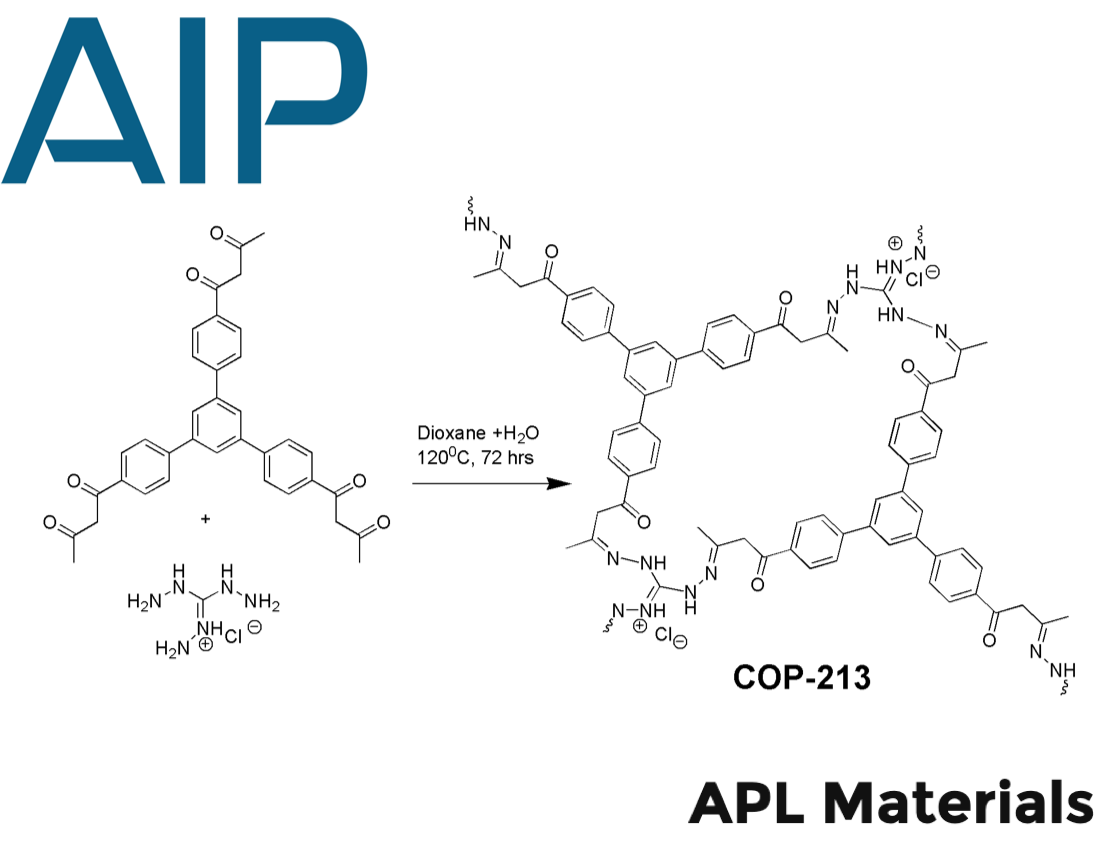
The chemical fixation of CO2 with epoxides to cyclic carbonate is an attractive 100% atom economic reaction. It is a safe and green alternative to the route from diols and toxic phosgene. In this manuscript, we present a new zwitterionic π–conjugated catalyst (Covalent Organic Polymer, COP-213) based on guanidinium and β-ketoenol functionality, which is synthesized from triaminoguanidinium halide and β-ketoenols via the ampoule method at 120 °C. The catalyst is characterized by FTIR-attenuated total reflection (ATR), Powder X-Ray diffraction, thermogravimetric analysis, XPS, and for surface area Brunauer–Emmett–Teller and CO2 uptake. It shows quantitative conversion and selectivity in chemical fixation of CO2 to epoxides under ambient conditions and without the need for cocatalysts, metals, solvent, or pressure. The catalyst can be recycled at least three times without the loss of reactivity.
 V. Rozyyev
,
C. T. Yavuz*
Chem, 3, 5, 719-721, (2017).
DOI:
10.1016/j.chempr.2017.10.014
Raw natural gas is predominantly methane (up to 95%) but also contains larger hydrocarbons such as ethane
and propane, acidic gases such as H2S
and CO2, and considerable amounts
of water. In some reserves, H2S can
reach up to 20%, and water content
can be as much as 5%. CO2 in natural
gas, from ppm levels up to 0.5%, is
less significant but noteworthy. Natural
gas treatment starts with the removal of
sludge and gas condensate, followed
by acid gas removal (mostly H2S) by
amine scrubbing. Regenerated H2S is
converted to elemental sulfur via the
Claus process or sulfuric acid by the
wet sulfuric acid process. Sweet (H2S and
CO2-free) natural gas is then dehydrated
with the use of glycols and
then separated from higher alkanes.
D. Thirion, Y. Kwon,
V. Rozyyev,
J. Byun,
C. T. Yavuz*
Chem. Mater., 28 (16), 5592–5595, (2016). DOI:
10.1021/acs.chemmater.6b02152.
Porous materials as adsorbents with high affinities to target molecules have great potential to facilitate environmentally important separations and remediation. One key challenge is to keep a reactive functionality inert while building a super structure. Protection or post-modification methods are limited because of the incomplete activation, and often require harsh conditions that also compromise the framework integrity. Here, a metal-free, one-pot, RT, deprotection-coupling, regioselective reaction is used for the first time to synthesize a porous network with high specific surface area (1035 m2/g) and easy post-functionalization. The obtained microporous polymer is a robust C-C bonded structure with alkyne and perfluorinated moieties. Aromatic fluorines readily undergo nucleophilic substitutions facilitating numerous post-modification possibilities, a particular feature that was not previously available.
D. Thirion,
V. Rozyyev, J. Park, Y. Jung, M. Atilhan,
C. T. Yavuz*
Phys. Chem. Chem. Phys., 18, 14177-14181, (2016). DOI:
10.1039/C6CP01382A

Liquid, solvated amine based carbon capture is the core of all commercial or planned CO2 capture operations. Despite the intense research, few have looked systematically into the nature of amine molecules and their CO2 interaction. Here, we report a systematic introduction of linear ethylene amines on the walls of highly porous Davankov type network structures through simple bromination intermediates. Surprisingly, isosteric heats of CO2 adsorption show a clear linear trend with the increase in the length of the tethered amine pendant groups, leading to a concerted cooperative binding with additional H-bonding contributions from the unassociated secondary amines. CO2 uptake capacities multiply with the nitrogen content, up to an unprecedented four to eight times of the starting porous network under flue gas conditions. The reported procedure can be generalized to all porous media with the robust hydrocarbon framework in order to convert them into effective CO2 capture adsorbents.


 M. Garai, V. Rozyyev, Z. Ullah, A. Jamal, C. T. Yavuz*


