Redox and Nonredox CO2 Utilization: Dry Reforming of Methane and Catalytic Cyclic Carbonate Formation

S. Subramanian, Y. Song, D. Kim, C. T. Yavuz*
ACS Energy Lett., 5, 5, 1689–1700 (2020). Invited Review
DOI: 10.1021/acsenergylett.0c00406

CO2 emissions are too large to tackle with a single process, but a combination of avoidance with chemical utilization may be able to slow global warming. In this Focus Review, we identify two large-scale CO2 conversion processes based on their viability and opposite energy requirements. In the high-energy, stationary path, CO2 reforming of methane could provide gigatons of CO2 utilization through synthesis gas. The main problem is the lack of a durable, effective, low-cost dry reforming catalyst. The exothermic cyclic carbonate formation from CO2 and organic epoxides offers a low-energy, mobile, nonredox route. The catalysts, however, must be metal-free and robust, have a high surface area, and be low-cost while being easily scalable. These two processes could potentially address at least a quarter of all current CO2 emissions.
[Continue reading...]

Triazatruxene-Based Ordered Porous Polymer: High Capacity CO2, CH4, and H2 Capture, Heterogeneous Suzuki–Miyaura Catalytic Coupling, and Thermoelectric Properties

A. E. Sadak*, E. Karakuş*, Y. Chumakov, N. A. Dogan, C. T. Yavuz 
ACS Appl. Energy Mater., 3, 5, 4983–4994 (2020). 

A hypercrosslinked ultramicroporous and ordered organic polymer network was synthesized from a planar trimer indole building block called triazatruxene (TAT) through anhydrous FeCl3 catalyzed Friedel–Crafts alkylation using methylal as a crosslinker. The polymer network is stable in a variety of chemicals and thermally durable. The hypercrosslinked network TATHCP shows a high BET (Brunauer–Emmet–Teller) specific surface area of 997 m2 g–1 with CO2 uptake capacity of 12.55 wt % at 273 K, 1.1 bar. Gas selectivities of 38.4 for CO2/N2, 7.8 for CO2/CH4, 40.6 for CO2/O2, and 32.1 for CO2/CO were achieved through IAST calculation. The PXRD analysis has revealed that TATHCP has a fully eclipsed structure in full agreement with Pawley refinement. The ordered 2D layers provide anisotropy that could be used in catalysis and thermoelectric measurements. After loading with Pd(II), TATHCP-Pd showed high catalytic activity in Suzuki–Miyaura cross coupling reaction with a wide range of reagents and excellent reaction yields of 90–98% with good recyclability. The structure of TATHCP-Pd was found to have two independent molecules of Pd(OAc)2 in the asymmetric unit cell which are arranged between two TATHCP layers. Thermoelectric properties of TATHCP showed a high Seebeck coefficient and ZT, a first and promising example in HCPs with applications in all-organic thermal energy recovery devices.
[Continue reading...]

Dry reforming of methane by stable Ni–Mo nanocatalysts on single-crystalline MgO

Y. Song, E. Ozdemir, S. Ramesh, A. Adishev, S. Subramanian, A. Harale, M. Albuali, B. A. Fadhel, A. Jamal, D. Moon, S. H. Choi, C. T. Yavuz*
Science, 367, 6479, 777-781 (2020).
DOI: 10.1126/science.aav2412

Large-scale carbon fixation requires high-volume chemicals production from carbon dioxide. Dry reforming of methane could provide an economically feasible route if coke- and sintering-resistant catalysts were developed. Here, we report a molybdenum-doped nickel nanocatalyst that is stabilized at the edges of a single-crystalline magnesium oxide (MgO) support and show quantitative production of synthesis gas from dry reforming of methane. The catalyst runs more than 850 hours of continuous operation under 60 liters per unit mass of catalyst per hour reactive gas flow with no detectable coking. Synchrotron studies also show no sintering and reveal that during activation, 2.9 nanometers as synthesized crystallites move to combine into stable 17-nanometer grains at the edges of MgO crystals above the Tammann temperature. Our findings enable an industrially and economically viable path for carbon reclamation, and the “Nanocatalysts On Single Crystal Edges” technique could lead to stable catalyst designs for many challenging reactions.

Perspective: Liyu Chen, Qiang Xu*, "Fewer defects, better catalysis?", p. 737
Research summary by Phil Szuromi, "Overcoming surface defects", p. 752-753
Highlighted in Chemistry World, C&ENNature Asia
Korean press release, English press release

Media Coverage:
Science Daily
Nanowerk
UPI
Phys.org
The Engineer
Wikipedia: 2020 in Science

Korean Media:
서울경제
해럴드경제
충청일보
교수신문
충남일보
베리타스알파
글로벌이코노믹
이뉴스투데이
뉴스핌
뉴스1
전자신문
국제뉴스
아시아경제
헬로디디
인더스트리뉴스
대전시티저널
에너지경제
아시아뉴스통신
[Continue reading...]

Catalytic non-redox carbon dioxide fixation in cyclic carbonates

S. Subramanian§, J. Oppenheim§, D. Kim§, T. S. Nguyen, W. M. H. Silo, B. Kim, W. A. Goddard III*, C. T. Yavuz* 
Chem, 5, 3232-3242 (2019). §: Equal contribution.
DOI: 10.1016/j.chempr.2019.10.009

If cycloaddition of CO2 to epoxides is to become a viable non-redox CO2 fixation path, it is crucial that researchers develop an active, stable, selective, metal-free, reusable, and cost-effective catalyst. To this end, we report here a new catalyst that is based on imidazolinium functionality and is synthesized from an unprecedented, one-pot reaction of the widely available monomers terephthalaldehyde and ammonium chloride. We show that this covalent organic polymer (COP)-222 exhibits quantitative conversion and selectivity for a range of substrates under ambient conditions and without the need for co-catalysts, metals, solvent, or pressure. COP-222 is recyclable and has been demonstrated to retain complete retention of activity for over 15 cycles. Moreover, it is scalable to at least a kilogram scale. We determined the reaction mechanism by using quantum mechanics (density functional theory), showing that it involves nucleophilic-attack-driven epoxide ring opening (ND-ERO). This contrasts with the commonly assumed mechanism involving the concerted addition of chemisorbed CO2.
[Continue reading...]

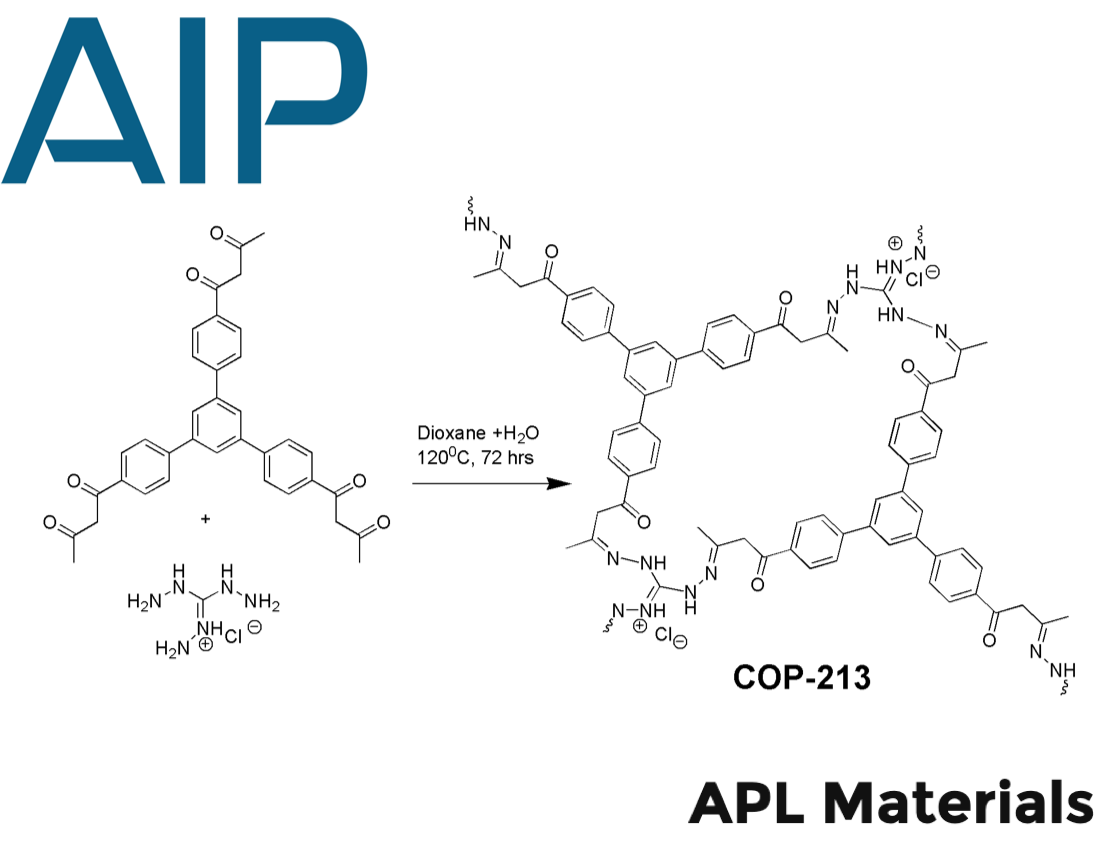
Zwitterion π-conjugated network polymer based on guanidinium and β-ketoenol as a heterogeneous organocatalyst for chemical fixation of CO2 into cyclic carbonates

M. Garai, V. Rozyyev, Z. Ullah, A. Jamal, C. T. Yavuz*
APL Mater., 7, 111102 (2019). Open Access
DOI: 10.1063/1.5122017

The chemical fixation of CO2 with epoxides to cyclic carbonate is an attractive 100% atom economic reaction. It is a safe and green alternative to the route from diols and toxic phosgene. In this manuscript, we present a new zwitterionic π–conjugated catalyst (Covalent Organic Polymer, COP-213) based on guanidinium and β-ketoenol functionality, which is synthesized from triaminoguanidinium halide and β-ketoenols via the ampoule method at 120 °C. The catalyst is characterized by FTIR-attenuated total reflection (ATR), Powder X-Ray diffraction, thermogravimetric analysis, XPS, and for surface area Brunauer–Emmett–Teller and CO2 uptake. It shows quantitative conversion and selectivity in chemical fixation of CO2 to epoxides under ambient conditions and without the need for cocatalysts, metals, solvent, or pressure. The catalyst can be recycled at least three times without the loss of reactivity. 
[Continue reading...]

Sustainable porous polymer catalyst for size-selective cross-coupling reactions

S. Kim, B. Kim, N. A. Dogan, C. T. Yavuz*
ACS Sustain. Chem. Eng., 7, 10865-10872 (2019).
DOI: 10.1021/acssuschemeng.9b01729

A new, high surface area, nanoporous polymer (COP-220) was synthesized using sustainable building blocks, namely, a food coloring dye (erythrosine B) and a commercial alkyne. During the Sonogashira coupling, it is observed that Pd and Cu ions and triphenylphosphine ligands of the catalyst get trapped inside the pores. The remnant synthesis catalyst components were characterized in detail and were tested as a new catalyst for Suzuki–Miyaura coupling reactions. COP-220 showed conversion yields comparable to the commercial homogeneous catalyst Pd(PPh3)2Cl2 with an additional advantage of size-dependent catalytic activity when bulkier substrates were used. COP-220 was highly stable under thermal and chemical treatments and recyclable with no loss of activity. These findings show a clear need for extensive characterization of nanoporous polymers made through cross-coupling reactions and the potential of the trapped catalysts for new catalytic activity without additional loading.
[Continue reading...]

Highly efficient catalytic cyclic carbonate formation by pyridyl salicylimines

S. Subramanian, J. Park, J. Byun, Y. Jung, C. T. Yavuz*
ACS Appl. Mater. Interfaces, accepted.
DOI: 10.1021/acsami.8b00485

Cyclic carbonates as industrial commodities offer a viable non-redox carbon dioxide fixation, and suitable heterogeneous catalysts are vital for their widespread implementation. Here we report a highly efficient heterogeneous catalyst for CO2 addition to epoxides based on a newly identified active catalytic pocket consisting of pyridine, imine and phenol moieties. The polymeric, metal-free catalyst derived from this active site converts less reactive styrene oxide under atmospheric pressure in quantitative yield and selectivity to the corresponding carbonate. The catalyst doesn’t need additives, solvents, metals or co-catalysts, can be reused at least 10 cycles without loss of activity, and scaled up easily to a kg scale. DFT calculations reveal that the nucleophilicity of pyridine base gets stronger due to the conjugated imines and H-bonding from phenol accelerates the reaction forward by stabilizing the intermediate.

Link to the journal page
[Continue reading...]

Sustainable nanoporous benzoxazole networks as metal-free catalysts for one-pot oxidative self-coupling of amines by air oxygen

S. Subramanian, H. A. Patel, Y. Song, C. T. Yavuz*
Adv. Sustain. Syst., 1, 1700089, (2017).
DOI: 10.1002/adsu.201700089

The development of sustainable organocatalysts with porosity, high stability, and excellent catalytic activity offers a clean and green alternative to precious metal catalysts. Here, an efficient, nanoporous, heterogeneous benzoxazole catalyst is reported for aerobic oxidative coupling of amines. A molecular design strategy is presented to functionalize primary amines to produce valuable products under one-pot, open-air reaction conditions. Unprecedented and previously unknown, the stable imine intermediate catalyzes its own formation, also known as autocatalysis, enabling a direct and favorable access to amino acids, even if the catalysts are absent. The biomimetic benzoxazole catalysts developed here provide quantitative catalytic activity over 50 cycles with favorable kinetics with no degradation. This work also marks the first use of benzoxazoles for oxidative catalytic reactions.
[Continue reading...]

Crosslinked “poisonous” polymer: Thermochemically stable catalyst support for tuning chemoselectivity

S. Yun, S. Lee, S. Yook, H. A. Patel, C. T. Yavuz, M. Choi*
ACS Catalysis, 6, 2435-2442 (2016). DOI: 10.1021/acscatal.5b02613.
Designed catalyst poisons can be deliberately added in various reactions for tuning chemoselectivity. In general, the poisons are “transient” selectivity modifiers that are readily leached out during reactions and thus should be continuously fed to maintain the selectivity. In this work, we supported Pd catalysts on a thermochemically stable cross-linked polymer containing diphenyl sulfide linkages, which can simultaneously act as a catalyst support and a “permanent” selectivity modifier. The entire surfaces of the Pd clusters were ligated (or poisoned) by sulfide groups of the polymer support. The sulfide groups capping the Pd surface behaved like a “molecular gate” that enabled exceptionally discriminative adsorption of alkynes over alkenes. H2/D2 isotope exchange revealed that the capped Pd surface alone is inactive for H2 (or D2) dissociation, but in the presence of coflowing acetylene (alkyne), it becomes active for H2 dissociation as well as acetylene hydrogenation. The results indicated that acetylene adsorbs on the Pd surface and enables cooperative adsorption of H2. In contrast, ethylene (alkene) did not facilitate H2–D2 exchange, and hydrogenation of ethylene was not observed. The results indicated that alkynes can induce decapping of the sulfide groups from the Pd surface, while alkenes with weaker adsorption strength cannot. The discriminative adsorption of alkynes over alkenes led to highly chemoselective hydrogenation of various alkynes to alkenes with minimal overhydrogenation and the conversion of side functional groups. The catalytic functions can be retained over a long reaction period due to the high thermochemical stability of the polymer.
[Continue reading...]

Nanoporous networks as effective stabilisation matrixes for nanoscale zero valent iron and groundwater pollutant removal

P. D. Mines, J. Byun, Y. Hwang, H. A. Patel, H. R. Andersen, C. T. Yavuz*
J. Mater. Chem. A, 4, 632-639 (2016). DOI: 10.1039/C5TA05025A.


Nanoscale zero-valent iron (nZVI), with its reductive potentials and wide availability, offers degradative remediation of environmental contaminants. Rapid aggregation and deactivation hinder its application in real-life conditions. Here, we show that by caging nZVI into the micropores of porous networks, in particular Covalent Organic Polymers (COPs), we dramatically improved its stability and adsorption capacity, while still maintaining its reactivity. We probed the nZVI activity by monitoring azo bond reduction and Fenton type degradation of the naphthol blue black azo dye. We found that depending on the wettability of the host COP, the adsorption kinetics and dye degradation capacities changed. The hierarchical porous network of the COP structures enhanced the transport by temporarily holding azo dyes giving enough time and contact for the nZVI to act to break them. nZVI was also found to be more protected from the oxidative conditions since access is gated by the pore openings of COPs.
[Continue reading...]

Nanoporous Networks as Caging Supports for Uniform, Surfactant-free Co3O4 Nanocrystals and Their Applications in Energy Storage and Conversion

J. Byun, H. A. Patel, D. J. Kim, C. H. Jung, J. Y. Park*, J. W. Choi*, C. T. Yavuz* 
J. Mater. Chem. A, 3, 15489 - 15497, (2015). DOI: 10.1039/C5TA02825F.
Selected among "Hot Papers of 2015"


We report a new, surfactant-free method to produce Co3O4 nanocrystals with controlled sizes and high dispersity by caging templation of nanoporous networks. The morphologies of Co3O4 nanoparticles differ from wires to particulates by simply varying solvents. The composites of nanoparticles within network polymers are highly porous and are promising for many applications where accessible surface and aggregation prevention are important. The electrochemical performance of the composites demonstrates superior capacity and cyclic stability at a high current density (∼980 mA h g−1 at the 60th cycle at a current density of 1000 mA g−1). In a catalytic oxidation reaction of carbon monoxide, the composites exhibit a remarkable stability (in excess of 35 hours) and catalytic performance (T100 = 100 °C).
[Continue reading...]

In situ real time monitoring of Pt-VO2 nanoparticle-nanowire assembly by GISAXS

C. T. Yavuz*, S. Lee, B. Lee, M. H. Kim, J. M. Baik, C. Larson, S. Seifert, S. Vajda, R. E. Winans, M. Moskovits, G. D. Stucky, A. M. Wodtke
Proc. SPIE, Vol. 7679, 76792D (2010). [DOI] [pdf]

[Continue reading...]
 
Copyright © . ONE Lab - Prof. Cafer T. Yavuz - Posts · Comments
Theme Template by BTDesigner · Powered by Blogger