Catalytic non-redox carbon dioxide fixation in cyclic carbonates

S. Subramanian§, J. Oppenheim§, D. Kim§, T. S. Nguyen, W. M. H. Silo, B. Kim, W. A. Goddard III*, C. T. Yavuz* 
Chem, 5, 3232-3242 (2019). §: Equal contribution.
DOI: 10.1016/j.chempr.2019.10.009

If cycloaddition of CO2 to epoxides is to become a viable non-redox CO2 fixation path, it is crucial that researchers develop an active, stable, selective, metal-free, reusable, and cost-effective catalyst. To this end, we report here a new catalyst that is based on imidazolinium functionality and is synthesized from an unprecedented, one-pot reaction of the widely available monomers terephthalaldehyde and ammonium chloride. We show that this covalent organic polymer (COP)-222 exhibits quantitative conversion and selectivity for a range of substrates under ambient conditions and without the need for co-catalysts, metals, solvent, or pressure. COP-222 is recyclable and has been demonstrated to retain complete retention of activity for over 15 cycles. Moreover, it is scalable to at least a kilogram scale. We determined the reaction mechanism by using quantum mechanics (density functional theory), showing that it involves nucleophilic-attack-driven epoxide ring opening (ND-ERO). This contrasts with the commonly assumed mechanism involving the concerted addition of chemisorbed CO2.
[Continue reading...]

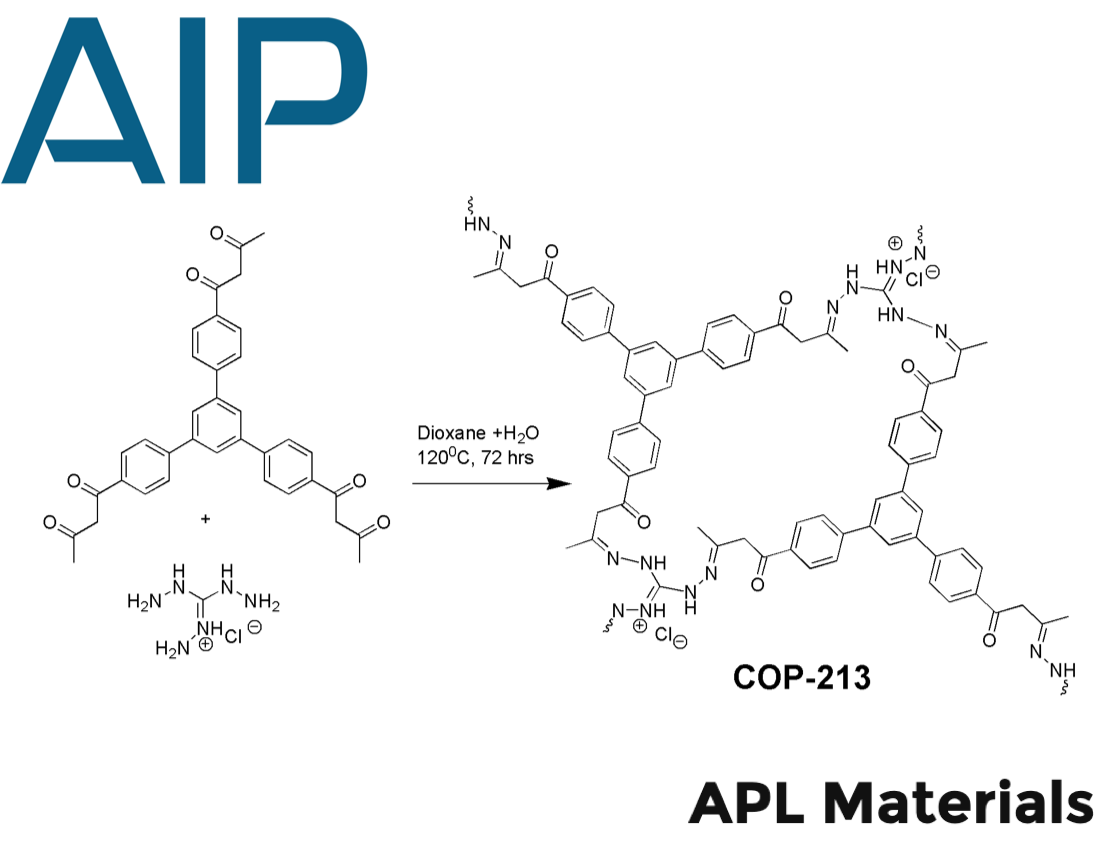
Zwitterion π-conjugated network polymer based on guanidinium and β-ketoenol as a heterogeneous organocatalyst for chemical fixation of CO2 into cyclic carbonates

M. Garai, V. Rozyyev, Z. Ullah, A. Jamal, C. T. Yavuz*
APL Mater., 7, 111102 (2019). Open Access
DOI: 10.1063/1.5122017

The chemical fixation of CO2 with epoxides to cyclic carbonate is an attractive 100% atom economic reaction. It is a safe and green alternative to the route from diols and toxic phosgene. In this manuscript, we present a new zwitterionic π–conjugated catalyst (Covalent Organic Polymer, COP-213) based on guanidinium and β-ketoenol functionality, which is synthesized from triaminoguanidinium halide and β-ketoenols via the ampoule method at 120 °C. The catalyst is characterized by FTIR-attenuated total reflection (ATR), Powder X-Ray diffraction, thermogravimetric analysis, XPS, and for surface area Brunauer–Emmett–Teller and CO2 uptake. It shows quantitative conversion and selectivity in chemical fixation of CO2 to epoxides under ambient conditions and without the need for cocatalysts, metals, solvent, or pressure. The catalyst can be recycled at least three times without the loss of reactivity. 
[Continue reading...]

Fluorinated covalent organic polymers for high performance sulfur cathodes in lithium–sulfur batteries

H. Shin§, D. Kim§, H. J. Kim§, J. Kim, K. Char*, C. T. Yavuz*, J. W. Choi*
Chem. Mater., accepted (2019). §: Equal contribution
DOI: 10.1021/acs.chemmater.9b01986

Lithium–sulfur (Li–S) batteries by far offer higher theoretical energy density than that of the commercial lithium-ion battery counterparts, but suffer predominantly from an irreversible shuttling process involving lithium polysulfides. Here, we report a fluorinated covalent organic polymer (F-COP) as a template for high performance sulfur cathodes in Li–S batteries. The fluorination allowed facile covalent attachment of sulfur to a porous polymer framework via nucleophilic aromatic substitution reaction (SNAr), leading to high sulfur content, e.g., over 70 wt %. The F-COP framework was microporous with 72% of pores within three well-defined pore sizes, viz. 0.58, 1.19, and 1.68 nm, which effectively suppressed polysulfide dissolution via steric and electrostatic hindrance. As a result of the structural features of the F-COP, the resulting sulfur electrode exhibited high electrochemical performance of 1287.7 mAh g–1 at 0.05C, 96.4% initial Columbic efficiency, 70.3% capacity retention after 1000 cycles at 0.5C, and robust operation for a sulfur loading of up to 4.1 mgsulfur cm–2. Our findings suggest the F-COP family with the adaptability of SNAr chemistry and well-defined microporous structures as useful frameworks for highly sustainable sulfur electrodes in Li–S batteries.
[Continue reading...]

Processing nanoporous organic polymers in liquid amines

J. Byun*, D. Thirion, C. T. Yavuz
Beilstein J. Nanotech., 10, 1844–1850 (2019). Open Access 
DOI: 10.3762/bjnano.10.179

Rigid network structures of nanoporous organic polymers provide high porosity, which is beneficial for applications such as gas sorption, gas separation, heterogeneous (photo)catalysis, sensing, and (opto)electronics. However, the network structures are practically insoluble. Thus, the processing of nanoporous polymers into nanoparticles or films remains challenging. Herein, we report that nanoporous polymers made via a Knoevenagel-like condensation can be easily processed into nanoparticles (115.7 ± 40.8 nm) or a flawless film by using liquid amines as a solvent at elevated temperatures. FTIR spectra revealed that the carboxyl groups in the nanoporous polymers act as reactive sites for amines, forming new functionalities and spacing the polymeric chains to be dissolved in the liquid amines. The processed film was found to be CO2-philic despite the low surface area, and further able to be transformed into a fine carbon film by thermal treatment.
[Continue reading...]

High-capacity methane storage in flexible alkane-linked porous aromatic network polymers

V. Rozyyev, D. Thirion, R. Ullah, J. Lee, M. Jung, H. Oh, M. Atilhan*, C. T. Yavuz*
Nat. Energy, 4, 604-611, (2019).
DOI: 10.1038/s41560-019-0427-x
Readcube link to read for free

Adsorbed natural gas (ANG) technology is a viable alternative to conventional liquefied or compressed natural-gas storage. Many different porous materials have been considered for adsorptive, reversible methane storage, but fall short of the US Department of Energy targets (0.5 g g−1, 263 l l−1). Here we prepare a flexible porous polymer, made from benzene and 1,2-dichloroethane in kilogram batches, that has a high methane working capacity of 0.625 g g−1 and 294 l l−1 when cycled between 5 and 100 bar pressure. We suggest that the flexibility provides rapid desorption and thermal management, while the hydrophobicity and the nature of the covalently bonded framework allow the material to tolerate harsh conditions. The polymer also shows an adsorbate memory effect, where a less adsorptive gas (N2) follows the isotherm profile of a high-capacity adsorbate (CO2), which is attributed to the thermal expansion caused by the adsorption enthalpy. The high methane capacity and memory effect make flexible porous polymers promising candidates for ANG technology.
[Continue reading...]

Sustainable synthesis of superhydrophobic perfluorinated nanoporous networks for small molecule separation

S. Kim§, D. Thirion§, T. S. Nguyen, B. Kim, N. A. Dogan, C. T. Yavuz* 
Chem. Mater., 31, 14, 5206-5213, (2019). §: Equal contribution
DOI: 10.1021/acs.chemmater.9b01447

Nanoporous polymers offer great promise in chemical capture and separations because of their versatility, scalability, and robust nature. Here, we report a general methodology for one-pot, metal-free, and room-temperature synthesis of nanoporous polymers by highly stable carbon–carbon bond formation. Three new polymers, namely, COP-177, COP-178, and COP-179, are derived from widely available perfluoroarenes and found to be superhydrophobic, microporous, and highly stable against heat, acid, base, and organic solvents. Nitrile, amine, and ether functionalities were successfully installed by SNAr-type postfunctionalization and were shown to increase CO2 uptake twice and CO2/N2 selectivity 4-fold. Due to its inherent superhydrophobicity, COP-177 showed high organic solvent uptake both in liquid and vapor form. Furthermore, in a first of its kind, by combining microporosity and hydrophobicity, COP-177 separated two small molecules with the same boiling point in a continuous column setting.
[Continue reading...]

Polypyrrole decorated mechanically robust conductive nanocomposites via solution blending and in-situ polymerization techniques

M. Zahra, S. Zulfiqar, C. T. Yavuz, H. S. Kweon, M. I. Sarwar*
Ind. Eng. Chem. Res., 58, 25, 10886-10893 (2019).
DOI: 10.1021/acs.iecr.9b01187

Polypyrrole grafted polystyrene-b-poly(ethylene-ran-butylene)-b-polystyrene (SEBS-g-PPy)/multiwall carbon nanotubes (MWCNTs) conductive nanocomposites were fabricated using two different approaches. The approach of system-I involved primarily the grafting of PPy on SEBS and its subsequent composites with nanotubes. In system-II in situ polymerization/grafting of PPy on SEBS was carried out along with MWCNTs yielding nanomaterials. Presynthesized SEBS-g-PPy and nanocomposites were characterized by Fourier transform infrared spectroscopy, NMR, field emission scanning electron microscopy, transmission electron microscopy, and electrical, mechanical, and thermal properties. The π–π stacking interactions between PPy of SEBS-g-PPy and MWCNTs rendered ample dispersion of the nanotubes in system-II relative to system-I. The electrical conductivity and tensile data showed improvement in these properties of nanocomposites and that system-II nanocomposites can sustain higher stresses, is stiffer, and can absorb more energy before breaking. Thermal stability of both the systems was improved relative to the matrices, and decomposition temperatures were found to increase from 437 to 568 °C. Relative improvement in electrical, thermal and tensile properties were observed for system-II nanocomposites rather than for system-I nanocomposites.
[Continue reading...]

Inversion of dispersion: Colloidal stability of calixarene modified metal-organic framework nanoparticles in non-polar media

U. Jeong, N. A. Dogan, M. Garai, T. S. Nguyen, J. F. Stoddart, C. T. Yavuz* 
J. Am. Chem. Soc., accepted, (2019).
DOI: 10.1021/jacs.9b04198

Making metal-organic frameworks (MOFs) which are stabilized in non-polar media is not as straightforward as their inorganic nanoparticle counterparts, since surfactants penetrate through the porous structures or dissolve the secondary building units (SBUs) through ligand-exchange linker modulator mechanisms. Herein we report that calixarenes stabilize UIO-66 nanoparticles effectively by remaining outside the grains through size exclusion, without pores becoming blocked, all the while providing amphiphilicity that permits the formation of stable colloidal dispersions with much narrower size distributions. Using the UIO-66 dispersed solutions, we showed that smooth films from an otherwise immiscible polystyrene can be made feasibly.
[Continue reading...]

Photochemically-enhanced Selective Adsorption of Gold Ions on Tannin-coated Porous Polymer Microspheres

J. Kim, K. R. Kim, Y. Hong, S. Choi, C. T. Yavuz, J. W. Kim*, Y. S. Nam*
ACS Appl. Mater. Interfaces, 11, 24, 21915-21925 (2019).
DOI: 10.1021/acsami.9b05197

Metal recovery from electronic waste and industrial wastewater has attracted increasing attention to recycle precious metals and inhibit the emission of hazardous heavy metals. However, the selective recovery of precious metals with a large quantity is still very challenging because wastewater contains a variety of different cations while precious metal ions are relatively scarce. Here, we introduce a simple method to selectively increase the adsorption of gold ions using tannin-coated porous polymer microspheres through photochemical reduction. Mesoporous poly(ethylene glycol dimethacrylate-co-acrylonitrile) microspheres with an average pore diameter of 13.8 nm were synthesized and used as an adsorbent matrix. Tannic acid (TA) was deposited onto the internal pores of the polymer matrix by simple immersion in an aqueous milieu. TA coatings increased the maximum number of adsorbed gold ions by 1.3 times because of the well-known metal ion chelation of TA. Under light illumination, the maximum number of adsorbed gold ions dramatically increased by 6.1 times. We examined two distinct mechanisms presumably involved in the enhanced adsorption: the photooxidation of TA and plasmon-induced hot electrons. Moreover, TA-coated microspheres exhibited remarkable selectivity for gold ions among competing metal ions commonly found in waste resources. This work suggests that the photochemically activated TA can serve as an excellent adsorbent for the selective and efficient recovery of gold ions from wastewater.
[Continue reading...]

Sustainable porous polymer catalyst for size-selective cross-coupling reactions

S. Kim, B. Kim, N. A. Dogan, C. T. Yavuz*
ACS Sustain. Chem. Eng., 7, 10865-10872 (2019).
DOI: 10.1021/acssuschemeng.9b01729

A new, high surface area, nanoporous polymer (COP-220) was synthesized using sustainable building blocks, namely, a food coloring dye (erythrosine B) and a commercial alkyne. During the Sonogashira coupling, it is observed that Pd and Cu ions and triphenylphosphine ligands of the catalyst get trapped inside the pores. The remnant synthesis catalyst components were characterized in detail and were tested as a new catalyst for Suzuki–Miyaura coupling reactions. COP-220 showed conversion yields comparable to the commercial homogeneous catalyst Pd(PPh3)2Cl2 with an additional advantage of size-dependent catalytic activity when bulkier substrates were used. COP-220 was highly stable under thermal and chemical treatments and recyclable with no loss of activity. These findings show a clear need for extensive characterization of nanoporous polymers made through cross-coupling reactions and the potential of the trapped catalysts for new catalytic activity without additional loading.
[Continue reading...]

Radioactive Strontium Removal from Seawater by a MOF via Two-Step Ion Exchange

M. Garai, C. T. Yavuz*
Chem, 5 (4), 750-752 (2019). Preview 
DOI: 10.1016/j.chempr.2019.03.020

Radioactive waste, such as 90Sr, 134Cs, and 131I, from the Fukushima nuclear spill highlighted the need to find effective adsorbents for scrubbing radioactive ions from seawater. In this issue of Chem, Wang and colleagues report a remarkably 90Sr-selective metal-organic framework (SZ-4) that operates with a two-step ion-exchange mechanism and at a wide pH range while being active and intact when tested in actual seawater.

Link to the journal website
[Continue reading...]

A combined experimental and theoretical study on gas adsorption performance of amine and amide porous polymers

R. Ullah, H. A. Patel, S. Aparicio, C. T. Yavuz*, M. Atilhan*
Micropor. Mesopor. Mater., 279, 61-72 (2019).
DOI: 10.1016/j.micromeso.2018.12.011

In this manuscript, we report synthesis, characterization and application of amine and amide type covalent organic frameworks as CO2 adsorbent materials at various isotherms and wide pressure conditions. Furthermore, we also report a detailed density functional theory investigation of the studied adsorbents in order to explain their adsorption behaviors and provide comparisons with experimental results. The objective of this work was to investigate custom design porous polymers by building amine and amide functionalities in the final structures, whether they have efficient CO2 capturing performances at wide process conditions that covers both low and high pressure end applications to cover either pre- or post-combustion processes. On the other hand, energy storage performances of these materials were tested by performing H2 sorption experiments as well. Two porous polymers, namely COP-9 and COP-10, were characterized with BET, TGA and FTIR to evaluate the physical properties of studied porous polymers and then were tested for CO2, N2 and H2 adsorption both at low and high pressures. Studied materials were found to have compelling adsorption capacity mostly at high pressures and have very good selectivity for CO2/N2 and CO2/H2 respectively.
[Continue reading...]

Nanoporous Polymer Microspheres with Nitrile and Amidoxime Functionalities for Gas Capture and Precious Metal Recovery from E-Waste

N. A. Dogan, Y. Hong, E. Ozdemir, C. T. Yavuz*
ACS Sustain. Chem. Eng., 7 (1), 123–128 (2019).
Invited paper for the special issue on advanced porous materials
DOI: 10.1021/acssuschemeng.8b05490 

Nanoporous materials could offer sustainable solutions to gas capture and precious metal recovery from electronic waste. Despite this potential, few reports combine target functionalities with physical properties such as morphology control. Here, we report a nanoporous polymer with microspherical morphology that could selectively capture gold from a mixture of 15 common transition metals. When its nitriles are converted into amidoxime, the capacity increases more than 20-fold. Amidoximes are also very effective in CO2 binding and show a record high CO2/CH4 selectivity of 24 for potential use in natural gas sweetening. The polymer is successfully synthesized in 1 kg batches starting from sustainable inexpensive building blocks without the need for costly catalysts. Because the morphology is controlled from the beginning, the nanoporous materials studied in lab scale could easily be moved into respective industries.

Link to the journal webpage
[Continue reading...]
 
Copyright © . ONE Lab - Prof. Cafer T. Yavuz - Posts · Comments
Theme Template by BTDesigner · Powered by Blogger