Redox and Nonredox CO2 Utilization: Dry Reforming of Methane and Catalytic Cyclic Carbonate Formation

S. Subramanian, Y. Song, D. Kim, C. T. Yavuz*
ACS Energy Lett., 5, 5, 1689–1700 (2020). Invited Review
DOI: 10.1021/acsenergylett.0c00406

CO2 emissions are too large to tackle with a single process, but a combination of avoidance with chemical utilization may be able to slow global warming. In this Focus Review, we identify two large-scale CO2 conversion processes based on their viability and opposite energy requirements. In the high-energy, stationary path, CO2 reforming of methane could provide gigatons of CO2 utilization through synthesis gas. The main problem is the lack of a durable, effective, low-cost dry reforming catalyst. The exothermic cyclic carbonate formation from CO2 and organic epoxides offers a low-energy, mobile, nonredox route. The catalysts, however, must be metal-free and robust, have a high surface area, and be low-cost while being easily scalable. These two processes could potentially address at least a quarter of all current CO2 emissions.
[Continue reading...]

Triazatruxene-Based Ordered Porous Polymer: High Capacity CO2, CH4, and H2 Capture, Heterogeneous Suzuki–Miyaura Catalytic Coupling, and Thermoelectric Properties

A. E. Sadak*, E. Karakuş*, Y. Chumakov, N. A. Dogan, C. T. Yavuz 
ACS Appl. Energy Mater., 3, 5, 4983–4994 (2020). 

A hypercrosslinked ultramicroporous and ordered organic polymer network was synthesized from a planar trimer indole building block called triazatruxene (TAT) through anhydrous FeCl3 catalyzed Friedel–Crafts alkylation using methylal as a crosslinker. The polymer network is stable in a variety of chemicals and thermally durable. The hypercrosslinked network TATHCP shows a high BET (Brunauer–Emmet–Teller) specific surface area of 997 m2 g–1 with CO2 uptake capacity of 12.55 wt % at 273 K, 1.1 bar. Gas selectivities of 38.4 for CO2/N2, 7.8 for CO2/CH4, 40.6 for CO2/O2, and 32.1 for CO2/CO were achieved through IAST calculation. The PXRD analysis has revealed that TATHCP has a fully eclipsed structure in full agreement with Pawley refinement. The ordered 2D layers provide anisotropy that could be used in catalysis and thermoelectric measurements. After loading with Pd(II), TATHCP-Pd showed high catalytic activity in Suzuki–Miyaura cross coupling reaction with a wide range of reagents and excellent reaction yields of 90–98% with good recyclability. The structure of TATHCP-Pd was found to have two independent molecules of Pd(OAc)2 in the asymmetric unit cell which are arranged between two TATHCP layers. Thermoelectric properties of TATHCP showed a high Seebeck coefficient and ZT, a first and promising example in HCPs with applications in all-organic thermal energy recovery devices.
[Continue reading...]

Quantifying nitrogen effect on CO2 capture using isoporous network polymers

T. S. Nguyen, C. T. Yavuz*
Chem. Commun., 56, 4273-4275 (2020).
DOI: 10.1039/D0CC00982B
Cover Image DOI: 10.1039/D0CC90168G


The impact of nitrogen atoms on CO2 binding was evaluated for two isostructural porous bisimidazole-linked polymers (BILPs), which serendipitously had identical surface areas and pore size distributions, a very rare observation. The two structures differ only in the core of the trialdehyde component, the nitrogen atom (BILP-19) versus benzene ring (BILP-5). Such a slight difference, however, has brought about a stronger CO2 capture capacity of BILP-19 and hence increased CO2/N2 separation capability.
[Continue reading...]

Dry reforming of methane by stable Ni–Mo nanocatalysts on single-crystalline MgO

Y. Song, E. Ozdemir, S. Ramesh, A. Adishev, S. Subramanian, A. Harale, M. Albuali, B. A. Fadhel, A. Jamal, D. Moon, S. H. Choi, C. T. Yavuz*
Science, 367, 6479, 777-781 (2020).
DOI: 10.1126/science.aav2412

Large-scale carbon fixation requires high-volume chemicals production from carbon dioxide. Dry reforming of methane could provide an economically feasible route if coke- and sintering-resistant catalysts were developed. Here, we report a molybdenum-doped nickel nanocatalyst that is stabilized at the edges of a single-crystalline magnesium oxide (MgO) support and show quantitative production of synthesis gas from dry reforming of methane. The catalyst runs more than 850 hours of continuous operation under 60 liters per unit mass of catalyst per hour reactive gas flow with no detectable coking. Synchrotron studies also show no sintering and reveal that during activation, 2.9 nanometers as synthesized crystallites move to combine into stable 17-nanometer grains at the edges of MgO crystals above the Tammann temperature. Our findings enable an industrially and economically viable path for carbon reclamation, and the “Nanocatalysts On Single Crystal Edges” technique could lead to stable catalyst designs for many challenging reactions.

Perspective: Liyu Chen, Qiang Xu*, "Fewer defects, better catalysis?", p. 737
Research summary by Phil Szuromi, "Overcoming surface defects", p. 752-753
Highlighted in Chemistry World, C&ENNature Asia
Korean press release, English press release

Media Coverage:
Science Daily
Nanowerk
UPI
Phys.org
The Engineer
Wikipedia: 2020 in Science

Korean Media:
서울경제
해럴드경제
충청일보
교수신문
충남일보
베리타스알파
글로벌이코노믹
이뉴스투데이
뉴스핌
뉴스1
전자신문
국제뉴스
아시아경제
헬로디디
인더스트리뉴스
대전시티저널
에너지경제
아시아뉴스통신
[Continue reading...]

Catalytic non-redox carbon dioxide fixation in cyclic carbonates

S. Subramanian§, J. Oppenheim§, D. Kim§, T. S. Nguyen, W. M. H. Silo, B. Kim, W. A. Goddard III*, C. T. Yavuz* 
Chem, 5, 3232-3242 (2019). §: Equal contribution.
DOI: 10.1016/j.chempr.2019.10.009

If cycloaddition of CO2 to epoxides is to become a viable non-redox CO2 fixation path, it is crucial that researchers develop an active, stable, selective, metal-free, reusable, and cost-effective catalyst. To this end, we report here a new catalyst that is based on imidazolinium functionality and is synthesized from an unprecedented, one-pot reaction of the widely available monomers terephthalaldehyde and ammonium chloride. We show that this covalent organic polymer (COP)-222 exhibits quantitative conversion and selectivity for a range of substrates under ambient conditions and without the need for co-catalysts, metals, solvent, or pressure. COP-222 is recyclable and has been demonstrated to retain complete retention of activity for over 15 cycles. Moreover, it is scalable to at least a kilogram scale. We determined the reaction mechanism by using quantum mechanics (density functional theory), showing that it involves nucleophilic-attack-driven epoxide ring opening (ND-ERO). This contrasts with the commonly assumed mechanism involving the concerted addition of chemisorbed CO2.
[Continue reading...]

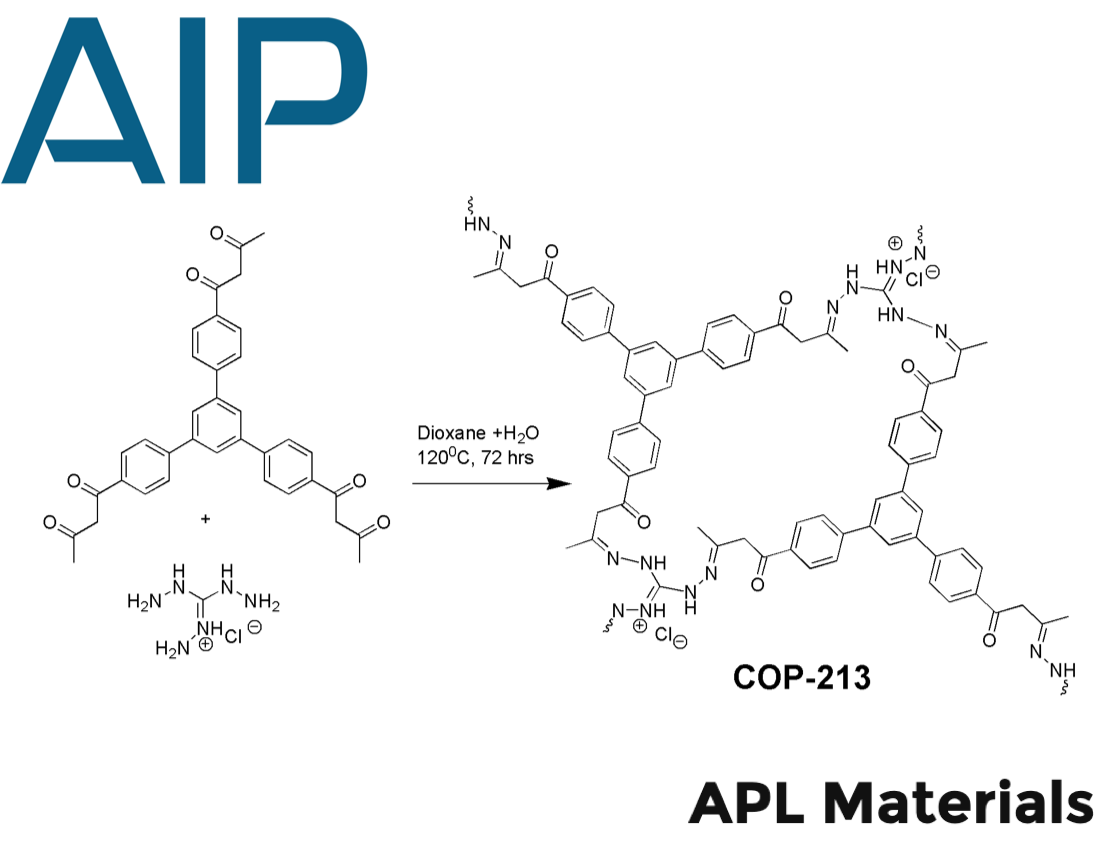
Zwitterion π-conjugated network polymer based on guanidinium and β-ketoenol as a heterogeneous organocatalyst for chemical fixation of CO2 into cyclic carbonates

M. Garai, V. Rozyyev, Z. Ullah, A. Jamal, C. T. Yavuz*
APL Mater., 7, 111102 (2019). Open Access
DOI: 10.1063/1.5122017

The chemical fixation of CO2 with epoxides to cyclic carbonate is an attractive 100% atom economic reaction. It is a safe and green alternative to the route from diols and toxic phosgene. In this manuscript, we present a new zwitterionic π–conjugated catalyst (Covalent Organic Polymer, COP-213) based on guanidinium and β-ketoenol functionality, which is synthesized from triaminoguanidinium halide and β-ketoenols via the ampoule method at 120 °C. The catalyst is characterized by FTIR-attenuated total reflection (ATR), Powder X-Ray diffraction, thermogravimetric analysis, XPS, and for surface area Brunauer–Emmett–Teller and CO2 uptake. It shows quantitative conversion and selectivity in chemical fixation of CO2 to epoxides under ambient conditions and without the need for cocatalysts, metals, solvent, or pressure. The catalyst can be recycled at least three times without the loss of reactivity. 
[Continue reading...]

Processing nanoporous organic polymers in liquid amines

J. Byun*, D. Thirion, C. T. Yavuz
Beilstein J. Nanotech., 10, 1844–1850 (2019). Open Access 
DOI: 10.3762/bjnano.10.179

Rigid network structures of nanoporous organic polymers provide high porosity, which is beneficial for applications such as gas sorption, gas separation, heterogeneous (photo)catalysis, sensing, and (opto)electronics. However, the network structures are practically insoluble. Thus, the processing of nanoporous polymers into nanoparticles or films remains challenging. Herein, we report that nanoporous polymers made via a Knoevenagel-like condensation can be easily processed into nanoparticles (115.7 ± 40.8 nm) or a flawless film by using liquid amines as a solvent at elevated temperatures. FTIR spectra revealed that the carboxyl groups in the nanoporous polymers act as reactive sites for amines, forming new functionalities and spacing the polymeric chains to be dissolved in the liquid amines. The processed film was found to be CO2-philic despite the low surface area, and further able to be transformed into a fine carbon film by thermal treatment.
[Continue reading...]

High-capacity methane storage in flexible alkane-linked porous aromatic network polymers

V. Rozyyev, D. Thirion, R. Ullah, J. Lee, M. Jung, H. Oh, M. Atilhan*, C. T. Yavuz*
Nat. Energy, 4, 604-611, (2019).
DOI: 10.1038/s41560-019-0427-x
Readcube link to read for free

Adsorbed natural gas (ANG) technology is a viable alternative to conventional liquefied or compressed natural-gas storage. Many different porous materials have been considered for adsorptive, reversible methane storage, but fall short of the US Department of Energy targets (0.5 g g−1, 263 l l−1). Here we prepare a flexible porous polymer, made from benzene and 1,2-dichloroethane in kilogram batches, that has a high methane working capacity of 0.625 g g−1 and 294 l l−1 when cycled between 5 and 100 bar pressure. We suggest that the flexibility provides rapid desorption and thermal management, while the hydrophobicity and the nature of the covalently bonded framework allow the material to tolerate harsh conditions. The polymer also shows an adsorbate memory effect, where a less adsorptive gas (N2) follows the isotherm profile of a high-capacity adsorbate (CO2), which is attributed to the thermal expansion caused by the adsorption enthalpy. The high methane capacity and memory effect make flexible porous polymers promising candidates for ANG technology.
[Continue reading...]

Sustainable synthesis of superhydrophobic perfluorinated nanoporous networks for small molecule separation

S. Kim§, D. Thirion§, T. S. Nguyen, B. Kim, N. A. Dogan, C. T. Yavuz* 
Chem. Mater., 31, 14, 5206-5213, (2019). §: Equal contribution
DOI: 10.1021/acs.chemmater.9b01447

Nanoporous polymers offer great promise in chemical capture and separations because of their versatility, scalability, and robust nature. Here, we report a general methodology for one-pot, metal-free, and room-temperature synthesis of nanoporous polymers by highly stable carbon–carbon bond formation. Three new polymers, namely, COP-177, COP-178, and COP-179, are derived from widely available perfluoroarenes and found to be superhydrophobic, microporous, and highly stable against heat, acid, base, and organic solvents. Nitrile, amine, and ether functionalities were successfully installed by SNAr-type postfunctionalization and were shown to increase CO2 uptake twice and CO2/N2 selectivity 4-fold. Due to its inherent superhydrophobicity, COP-177 showed high organic solvent uptake both in liquid and vapor form. Furthermore, in a first of its kind, by combining microporosity and hydrophobicity, COP-177 separated two small molecules with the same boiling point in a continuous column setting.
[Continue reading...]

A combined experimental and theoretical study on gas adsorption performance of amine and amide porous polymers

R. Ullah, H. A. Patel, S. Aparicio, C. T. Yavuz*, M. Atilhan*
Micropor. Mesopor. Mater., 279, 61-72 (2019).
DOI: 10.1016/j.micromeso.2018.12.011

In this manuscript, we report synthesis, characterization and application of amine and amide type covalent organic frameworks as CO2 adsorbent materials at various isotherms and wide pressure conditions. Furthermore, we also report a detailed density functional theory investigation of the studied adsorbents in order to explain their adsorption behaviors and provide comparisons with experimental results. The objective of this work was to investigate custom design porous polymers by building amine and amide functionalities in the final structures, whether they have efficient CO2 capturing performances at wide process conditions that covers both low and high pressure end applications to cover either pre- or post-combustion processes. On the other hand, energy storage performances of these materials were tested by performing H2 sorption experiments as well. Two porous polymers, namely COP-9 and COP-10, were characterized with BET, TGA and FTIR to evaluate the physical properties of studied porous polymers and then were tested for CO2, N2 and H2 adsorption both at low and high pressures. Studied materials were found to have compelling adsorption capacity mostly at high pressures and have very good selectivity for CO2/N2 and CO2/H2 respectively.
[Continue reading...]

Nanoporous Polymer Microspheres with Nitrile and Amidoxime Functionalities for Gas Capture and Precious Metal Recovery from E-Waste

N. A. Dogan, Y. Hong, E. Ozdemir, C. T. Yavuz*
ACS Sustain. Chem. Eng., 7 (1), 123–128 (2019).
Invited paper for the special issue on advanced porous materials
DOI: 10.1021/acssuschemeng.8b05490 

Nanoporous materials could offer sustainable solutions to gas capture and precious metal recovery from electronic waste. Despite this potential, few reports combine target functionalities with physical properties such as morphology control. Here, we report a nanoporous polymer with microspherical morphology that could selectively capture gold from a mixture of 15 common transition metals. When its nitriles are converted into amidoxime, the capacity increases more than 20-fold. Amidoximes are also very effective in CO2 binding and show a record high CO2/CH4 selectivity of 24 for potential use in natural gas sweetening. The polymer is successfully synthesized in 1 kg batches starting from sustainable inexpensive building blocks without the need for costly catalysts. Because the morphology is controlled from the beginning, the nanoporous materials studied in lab scale could easily be moved into respective industries.

Link to the journal webpage
[Continue reading...]

Structural Elucidation of Covalent Organic Polymers (COP) and Their Linker Effect on Gas Adsorption Performance via Density Functional Theory Approach

S. Aparicio*, C. T. Yavuz, M. Atilhan*
ChemistrySelect, 3, 8294– 8305 (2018).
DOI: 10.1002/slct.201801849

Investigation of the binding affinity gases on porous adsorbents are important for establishing understanding of effective carbon dioxide adsorption and design target specific sorbents for capturing hazardous gases for environmental protection and fuel upgrading. A Density Functional Theory (DFT) study that highlights the impact of covalent organic polymer (COP) design has been conducted to explain the molecular and electronic structure, investigate the interaction sites and elucidate the experimental findings on carbon dioxide (CO2) and nitrogen (N2) sorption on these porous structures. DFT calculations were used to infer the details of the type and the strength of the polymer – gas interaction modes at various interaction sites as well as to quantify short‐range interactions between the polymer – gas via topological characteristics analysis of intermolecular forces. Results obtained in this study were used to shed light on CO2 and N2 affinity of the studied polymer structures; interpretations regarding to the macroscopic behaviors were discussed and conclusions were attained on the characteristics of the adsorption type and mechanism.
[Continue reading...]

A catalytic role of surface silanol groups in CO2 capture on the amine-anchored silica support

M. Cho, J. Park, C. T. Yavuz, Y. Jung*
Phys. Chem. Chem. Phys., 20, 12149-12156 (2018).
DOI: 10.1039/C7CP07973G

A new mechanism of CO2 capture on the amine-functionalized silica support is demonstrated using density functional theory calculations, in which the silica surface not only acts as a support to anchor amines, but also can actively participate in the CO2 capture process through a facile proton transfer reaction with the amine groups. The surface-mediated proton transfer mechanism in forming a carbamate–ammonium product has lower kinetic barrier (8.1 kcal mol−1) than the generally accepted intermolecular mechanism (12.7 kcal mol−1) under dry conditions, and comparable to that of the water-assisted intermolecular mechanism (6.0 kcal mol−1) under humid conditions. These findings suggest that the CO2 adsorption on the amine-anchored silica surface would mostly occur via the rate-determining proton transfer step that is catalyzed by the surface silanol groups.
[Continue reading...]

Molecular Insights into Benzimidazole-linked Polymer Interactions with Carbon Dioxide and Nitrogen

S. Aparicio*, C. T. Yavuz, M. Atilhan*
ChemistrySelect, 3, 3691 – 3701 (2018).
DOI: 10.1002/slct.201800253

Investigation of the binding affinity gases on porous adsorbents are important for establishing understanding of effective carbon dioxide adsorption and design target specific sorbents for capturing hazardous gases for environmental protection and fuel upgrading. A density functional theory (DFT) study that highlights the impact of benzimidazole‐linked polymer structure design has been conducted to explain the molecular and electronic structure, investigate the interaction sites and elucidate the experimental results on carbon dioxide and nitrogen sorption on these porous structures. DFT calculations were used to infer the strength of the polymer – gas interaction modes as well as to quantify short‐range interactions between the polymer – gas via topological characteristics analysis of intermolecular forces. Obtained results shed light on the carbon dioxide and nitrogen affinity as well as the selectivity during the adsorption process, and yet conclusions were attained on the characteristics of the adsorption type and mechanism in this study.
[Continue reading...]

Highly efficient catalytic cyclic carbonate formation by pyridyl salicylimines

S. Subramanian, J. Park, J. Byun, Y. Jung, C. T. Yavuz*
ACS Appl. Mater. Interfaces, accepted.
DOI: 10.1021/acsami.8b00485

Cyclic carbonates as industrial commodities offer a viable non-redox carbon dioxide fixation, and suitable heterogeneous catalysts are vital for their widespread implementation. Here we report a highly efficient heterogeneous catalyst for CO2 addition to epoxides based on a newly identified active catalytic pocket consisting of pyridine, imine and phenol moieties. The polymeric, metal-free catalyst derived from this active site converts less reactive styrene oxide under atmospheric pressure in quantitative yield and selectivity to the corresponding carbonate. The catalyst doesn’t need additives, solvents, metals or co-catalysts, can be reused at least 10 cycles without loss of activity, and scaled up easily to a kg scale. DFT calculations reveal that the nucleophilicity of pyridine base gets stronger due to the conjugated imines and H-bonding from phenol accelerates the reaction forward by stabilizing the intermediate.

Link to the journal page
[Continue reading...]

Direct access to primary amines and particle morphology control in nanoporous CO2 sorbents

N. A. Dogan§, E. Ozdemir§, C. T. Yavuz*
ChemSusChem10, 2130-2134, (2017). DOI: 10.1002/cssc.201700190. §: Equal contribution


Chemical tuning of nanoporous, solid sorbents for an ideal CO2 binding requires unhindered amine functional groups on the pore walls. Although common for soluble organics, post-synthetic reduction of nitriles in porous networks often fail due to the insufficient and irreversible metal hydride penetration. Here, we synthesized a nanoporous network with pendant nitrile groups, microsphere morphology and in large scale. The hollow microspheres were easily decorated with primary amines through in situ reduction by widely available boranes. CO2 capture capacity of the modified sorbent was increased up to an eight times of the starting nanoporous network with a high heat of adsorption (98 kJ/mol). Surface area can be easily tuned between 1 and 354 m2/g. Average particle size (~50 µm) is also quite suitable for CO2 capture applications where processes like fluidized bed require spheres of micron sizes.
[Continue reading...]

Enhanced sorption cycle stability and kinetics of CO2 on lithium silicates using lithium ion channeling effect of TiO2 nanotubes

J. S. Lee, C. T. Yavuz*
Ind. Eng. Chem. Res., accepted.
DOI: 10.1021/acs.iecr.6b04918.


Lithium silicate (Li4SiO4) is a promising high temperature CO2 sorbent because of its large CO2 capacity at elevated temperatures with low materials cost. However, the conventional nonporous Li4SiO4 shows very poor CO2 adsorption kinetics. Thus, a Li4SiO4–TiO2 nanotubes complex was synthesized where LiOH and fumed silica would be calcined around TiO2 nanotubes. TiO2 nanotubes in Li4SiO4 structure functioning as open highways, lithium ions were able to channel through the bulky structure and enhance the sorption kinetics, leading the total adsorption capacity to near theoretical values. Furthermore, cyclic studies at 700 °C revealed strong stability over at least 10 cycles. These findings indicate that stability and kinetics of CO2 sorption can be greatly improved by the nanotube composites of known adsorbents.
[Continue reading...]

Monitoring instability of linear amine impregnated UiO-66 by in-situ temperature resolved powder X-ray diffraction

Y. Song, D. Thirion, S. Subramanian, M. S. Lah, C. T. Yavuz*
Micropor. Mesopor. Mater., 243, 85-90, (2017).
DOI: 10.1016/j.micromeso.2017.02.021.

Carbon dioxide capture requires stable porous solids like zirconium based metal-organic frameworks (MOFs) in order to make sequestration efforts feasible. Because of the weak binding at low CO2 partial pressures, oligomeric amines are commonly loaded on porous supports to maximize CO2 capture while attempting to keep porosity for enhanced diffusion. Here we show the first temperature resolved stability study of linear-amine impregnated UiO-66 by in-situ monitoring of the PXRD pattern. Our findings show that the crystal structure shows a contraction at temperatures as low as 80 °C and deforms considerably above 120 °C, leading to significant doubts about their applicability in CO2 capture from lean feeds. We confirm that all MOFs need to be thoroughly analyzed at least by means of PXRD at the process relevant temperatures, and reinforced before any plausible plans of application in CO2 capture.
[Continue reading...]

Carbon Dioxide Capture Adsorbents: Chemistry and Methods, A Tutorial Review

H. A. Patel, J. Byun, C. T. Yavuz*
ChemSusChem10, 7, 1303-1317, (2017). DOI: 10.1002/cssc.201601545.
View PDF here

Graphical Art by Ella Marushchenko.

Excess carbon dioxide (CO2) emissions and the inevitable consequences continuing to stimulate hard debate and awareness in both academic and public spaces, despite the clutter on understanding what really is needed to capture and store the unwanted CO2. Capture is the most costly, nearly 70 % of the price tag on the entire carbon capture and storage (CCS) operation. In this tutorial review, we describe and evaluate CO2 capture science and technology based on adsorbents in the context of chemistry and methods, after briefly introducing current status of CO2 emissions. An effective sorbent design is suggested, where six checkpoints are expected to be met: cost, capacity, selectivity, stability, recyclability and fast kinetics.
[Continue reading...]

Robust C–C bonded porous networks with chemically designed functionalities for improved CO2 capture from flue gas

D. Thirion, J. S. Lee, E. OzdemirC. T. Yavuz*
Beilstein J. Org. Chem., 12, 2274-2279, (2016). OpenAccess
Invited Paper for the thematic issue on "Organic Porous Materials". DOI: 10.3762/bjoc.12.220.


Effective carbon dioxide (CO2) capture requires solid, porous sorbents with chemically and thermally stable frameworks. Herein, we report two new carbon–carbon bonded porous networks that were synthesized through metal-free Knoevenagel nitrile–aldol condensation, namely the covalent organic polymer, COP-156 and 157. COP-156, due to high specific surface area (650 m2/g) and easily interchangeable nitrile groups, was modified post-synthetically into free amine- or amidoxime-containing networks. The modified COP-156-amine showed fast and increased CO2 uptake under simulated moist flue gas conditions compared to the starting network and usual industrial CO2 solvents, reaching up to 7.8 wt % uptake at 40 °C.

Keywords: C–C bond; CO2 capture; microporous materials; porous polymers; postmodification
[Continue reading...]
 
Copyright © . ONE Lab - Prof. Cafer T. Yavuz - Posts · Comments
Theme Template by BTDesigner · Powered by Blogger