Home » Posts filed under Mousumi
 M. Garai
,
V. Rozyyev,
Z. Ullah, A. Jamal,
C. T. Yavuz*
APL Mater., 7, 111102 (2019).
Open Access
DOI:
10.1063/1.5122017
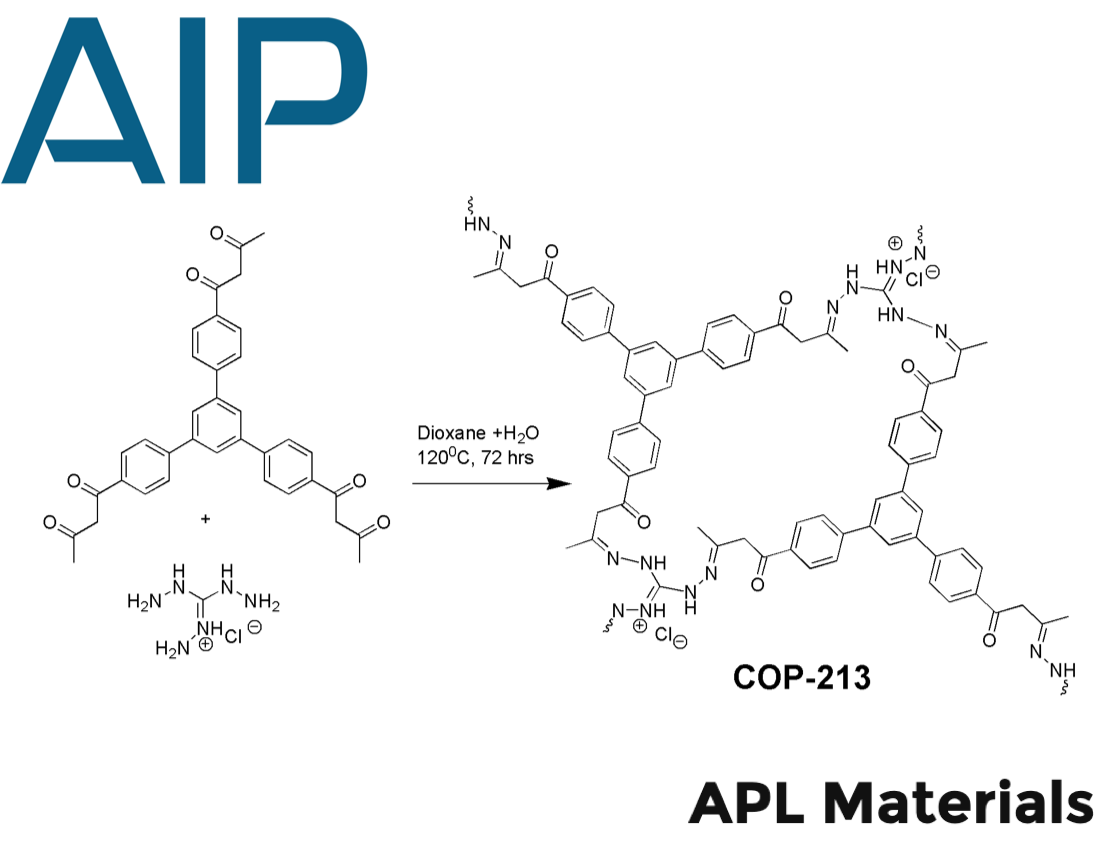
The chemical fixation of CO2 with epoxides to cyclic carbonate is an attractive 100% atom economic reaction. It is a safe and green alternative to the route from diols and toxic phosgene. In this manuscript, we present a new zwitterionic π–conjugated catalyst (Covalent Organic Polymer, COP-213) based on guanidinium and β-ketoenol functionality, which is synthesized from triaminoguanidinium halide and β-ketoenols via the ampoule method at 120 °C. The catalyst is characterized by FTIR-attenuated total reflection (ATR), Powder X-Ray diffraction, thermogravimetric analysis, XPS, and for surface area Brunauer–Emmett–Teller and CO2 uptake. It shows quantitative conversion and selectivity in chemical fixation of CO2 to epoxides under ambient conditions and without the need for cocatalysts, metals, solvent, or pressure. The catalyst can be recycled at least three times without the loss of reactivity.
U. Jeong,
N. A. Dogan,
M. Garai,
T. S. Nguyen, J. F. Stoddart,
C. T. Yavuz*
J. Am. Chem. Soc., accepted, (2019).
DOI:
10.1021/jacs.9b04198
Making metal-organic frameworks (MOFs) which are stabilized in non-polar media is not as straightforward as their inorganic nanoparticle counterparts, since surfactants penetrate through the porous structures or dissolve the secondary building units (SBUs) through ligand-exchange linker modulator mechanisms. Herein we report that calixarenes stabilize UIO-66 nanoparticles effectively by remaining outside the grains through size exclusion, without pores becoming blocked, all the while providing amphiphilicity that permits the formation of stable colloidal dispersions with much narrower size distributions. Using the UIO-66 dispersed solutions, we showed that smooth films from an otherwise immiscible polystyrene can be made feasibly.
M. Garai,
C. T. Yavuz*
Chem, 5 (4), 750-752 (2019).
Preview
DOI:
10.1016/j.chempr.2019.03.020
Radioactive waste, such as 90Sr, 134Cs, and 131I, from the Fukushima nuclear spill highlighted the need to find effective adsorbents for scrubbing radioactive ions from seawater. In this issue of Chem, Wang and colleagues report a remarkably 90Sr-selective metal-organic framework (SZ-4) that operates with a two-step ion-exchange mechanism and at a wide pH range while being active and intact when tested in actual seawater.
Link to the journal website


 M. Garai, V. Rozyyev, Z. Ullah, A. Jamal, C. T. Yavuz*

